The PLO and Arafat’s Rise to Prominence
Early Life and Background
Yasser Arafat was born on August 24, 1929, in Cairo, Egypt. His full name was Mohammed Abdel Rahman Abdel Raouf Arafat al-Qudwa al-Husseini, but he became widely known as Yasser Arafat, a name that symbolized his commitment to the Palestinian cause. Despite Cairo being commonly recorded as his birthplace, Arafat himself claimed he was born in Jerusalem, underscoring the centrality of that city to his identity and the Palestinian cause.
Arafat’s family was originally from Gaza, and his father, Abdel Raouf al-Qudwa, was a textile merchant, while his mother came from a well-known Palestinian family in Jerusalem. When his mother died, Arafat was sent to live with an uncle in Jerusalem for a short time before returning to Cairo. His early exposure to the Palestinian struggle and the wider Arab political landscape shaped his political consciousness from a young age.
As a teenager, Arafat witnessed the 1948 Arab-Israeli War, which resulted in the creation of the state of Israel and the displacement of hundreds of thousands of Palestinians, a formative event that left a lasting impact on his worldview. This conflict, known as the Nakba, or “Catastrophe,” became the bedrock of Arafat’s political aspirations, motivating him to dedicate his life to the Palestinian national cause.
Early Political Activity and Formation of Fatah
Arafat’s early political activities began while he was studying at King Fuad I University (now Cairo University), where he earned a degree in civil engineering. During his time in university, he became involved in the Palestinian nationalist movement, organizing student protests and raising funds to support Palestinian fighters during the Arab-Israeli conflict.
In the 1950s, while working as an engineer in Kuwait, Arafat helped found Fatah in 1959 along with several other Palestinian expatriates. Fatah, an acronym for “Harakat al-Tahrir al-Watani al-Filastini” (the Palestinian National Liberation Movement), quickly rose to prominence. Unlike other Arab political factions that sought to rely on Arab states to liberate Palestine, Fatah promoted an independent Palestinian movement that would not be subject to external influences. It sought to achieve Palestinian liberation primarily through armed struggle and guerrilla warfare, arguing that only direct action would bring attention to their cause.
By the 1960s, Fatah began carrying out cross-border raids into Israel, marking the beginning of Arafat’s long engagement with armed resistance. While Fatah’s operations were often small-scale and symbolic, they garnered international attention, forcing the world to acknowledge the existence of the Palestinian issue.
The PLO and Arafat’s Rise to Prominence
In 1964, the Palestine Liberation Organization (PLO) was founded with the support of the Arab League. Initially, the PLO was more a tool of Arab states than an independent Palestinian entity. However, this changed with the rise of Arafat, who became the chairman of the PLO in 1969.
Under Arafat’s leadership, Fatah gained prominence within the PLO, and the organization shifted from a primarily diplomatic entity to one that embraced armed struggle. The PLO’s charter called for the destruction of the state of Israel, and throughout the 1970s, the PLO launched numerous guerrilla attacks and bombings against Israeli targets, both military and civilian. These attacks were condemned by Israel and Western powers as acts of terrorism, but they also helped to put the Palestinian issue at the forefront of international discourse.
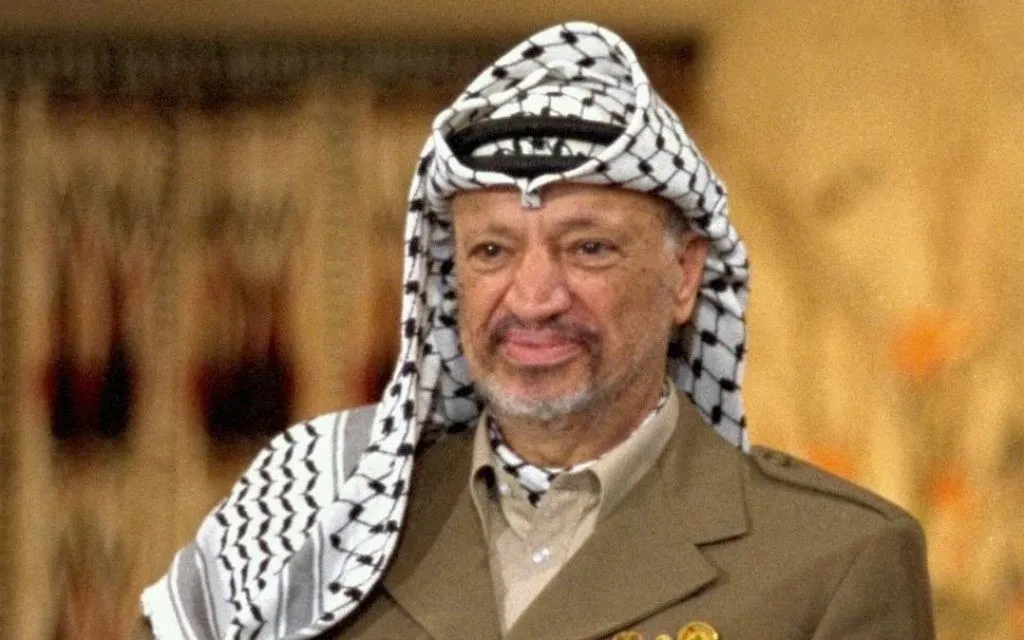
During this period, Arafat became the face of the Palestinian movement. His image, often seen in military fatigues and a keffiyeh draped over his head, became a symbol of the Palestinian resistance. Arafat skillfully balanced the roles of a militant leader and a political diplomat, often walking a fine line between supporting violent resistance and seeking diplomatic solutions.
Black September and International Attention
A critical event in Arafat’s career was the 1970 conflict in Jordan, known as “Black September.” The PLO, having been expelled from Israel and operating from Jordan, had established a quasi-state within the Jordanian kingdom, controlling areas and threatening the sovereignty of the Jordanian government. Tensions escalated, culminating in a violent confrontation between the Jordanian military and PLO forces, leading to the deaths of thousands of Palestinians.
Following the defeat of the PLO in Jordan, Arafat and the organization were forced to relocate to Lebanon, where they would remain active throughout the 1970s and early 1980s. The events of Black September, while a significant setback for Arafat and the PLO, brought international attention to the Palestinian cause. The conflict also demonstrated the complex relationships between Palestinian organizations and the governments of Arab countries, which were not always aligned with Palestinian aspirations.
The most notorious event associated with Black September was the kidnapping and murder of 11 Israeli athletes during the 1972 Munich Olympics by the Black September Organization, a faction of the PLO. Although Arafat claimed no direct involvement in the attack, it greatly damaged the PLO’s international standing, leading to further labeling of the organization as a terrorist group by many in the West.
PLO in Lebanon and Israeli Response
After its expulsion from Jordan, the PLO established its headquarters in Lebanon, from where it continued its attacks against Israel. The Israeli government responded with heavy military operations, including airstrikes and a full-scale invasion of Lebanon in 1982. Israel’s goal was to destroy the PLO infrastructure in Lebanon and to remove Arafat and his organization from its borders.
The Israeli invasion of Lebanon resulted in the siege of Beirut, during which Arafat and his leadership were forced to flee Lebanon under international pressure. This period marked a significant blow to the PLO, and the organization relocated once again, this time to Tunisia. Despite these setbacks, Arafat remained a central figure in the Palestinian national movement, continuing his leadership in exile.
Diplomatic Shifts and the 1980s
The 1980s marked a shift in Arafat’s approach. Realizing that armed struggle alone was not sufficient to achieve Palestinian independence, Arafat began to adopt a more diplomatic stance. This shift became evident during the First Intifada (1987-1993), a mass uprising by Palestinians in the West Bank and Gaza Strip against Israeli military rule.
The First Intifada was largely spontaneous and grassroots, characterized by civil disobedience, protests, and clashes between Palestinian civilians and Israeli soldiers. Arafat and the PLO, although initially surprised by the outbreak of the Intifada, sought to harness its momentum to push for a political solution.
During this period, Arafat and the PLO began to engage in secret negotiations with international actors, including the United States and Europe. In 1988, Arafat made a landmark speech at the UN General Assembly, during which he recognized Israel’s right to exist and called for peace negotiations based on the two-state solution. This marked a significant shift in the PLO’s stance, and it opened the door to future peace talks.
Oslo Accords and Arafat’s Diplomatic Triumph
Arafat’s biggest political achievement came in the 1990s with the Oslo Accords. After years of secret negotiations, the PLO and Israel signed the agreements in 1993. The accords established a framework for Palestinian self-governance in parts of the West Bank and Gaza, while recognizing the PLO as the legitimate representative of the Palestinian people.
The Oslo Accords were a historic breakthrough in the Israeli-Palestinian conflict. Arafat returned to the Palestinian territories after decades in exile and took charge of the newly created Palestinian Authority (PA), which was tasked with governing areas under Palestinian control. For his role in the peace process, Arafat, along with Israeli leaders Yitzhak Rabin and Shimon Peres, was awarded the Nobel Peace Prize in 1994.
The accords, however, were not without controversy. Many Palestinians felt that Arafat had made too many concessions without securing guarantees for statehood or the return of refugees. At the same time, many Israelis believed that Arafat could not be trusted to uphold the peace agreements. The assassination of Rabin in 1995 by a right-wing Israeli extremist further damaged the peace process, and violence escalated in the following years.
Collapse of the Peace Process and the Second Intifada
Despite the optimism surrounding the Oslo Accords, the peace process ultimately collapsed. Disagreements over core issues—such as the status of Jerusalem, the borders of a future Palestinian state, Israeli settlement expansion, and the right of return for Palestinian refugees—proved insurmountable.
In 2000, following the failure of the Camp David Summit, which was mediated by U.S. President Bill Clinton, the Second Intifada erupted. This uprising was far more violent than the first, with suicide bombings, rocket attacks, and Israeli military responses causing significant casualties on both sides.
Arafat’s role in the Second Intifada is a matter of debate. While he publicly called for peace, many in Israel and the West accused him of tacitly supporting the violence, leading to a significant decline in his international standing. Israel confined Arafat to his Ramallah compound, where he remained isolated and surrounded by Israeli forces for the last few years of his life.
Illness, Death, and Legacy
Arafat’s health deteriorated during his final years, and in October 2004, he fell gravely ill. He was flown to a military hospital in France, where he died on November 11, 2004. His death was met with widespread mourning among Palestinians, but it also sparked rumors and accusations that he had been poisoned. Despite multiple investigations, no conclusive evidence of foul play has ever been found.
Arafat’s legacy is deeply complex. To many Palestinians, he is a national hero who devoted his life to the cause of Palestinian independence. His leadership brought international attention to the plight of the Palestinians, and he is widely credited with transforming the Palestinian movement from a regional issue into a global concern.
However, Arafat’s leadership was also marked by controversy. His critics accuse him of failing to secure a lasting peace with Israel, missing key opportunities to achieve a two-state solution. Additionally, his authoritarian style of governance and accusations of corruption within the Palestinian Authority left a mixed legacy.
Conclusion
Yasser Arafat’s life spanned some of the most important events in modern Middle Eastern history. His transformation from a guerrilla leader to a Nobel Peace Prize-winning diplomat illustrates the complex and often contradictory nature of his leadership. While Arafat is celebrated by many for his dedication to the Palestinian cause, his legacy remains divisive, both within the Palestinian territories and in the broader international community.
Leave a Reply