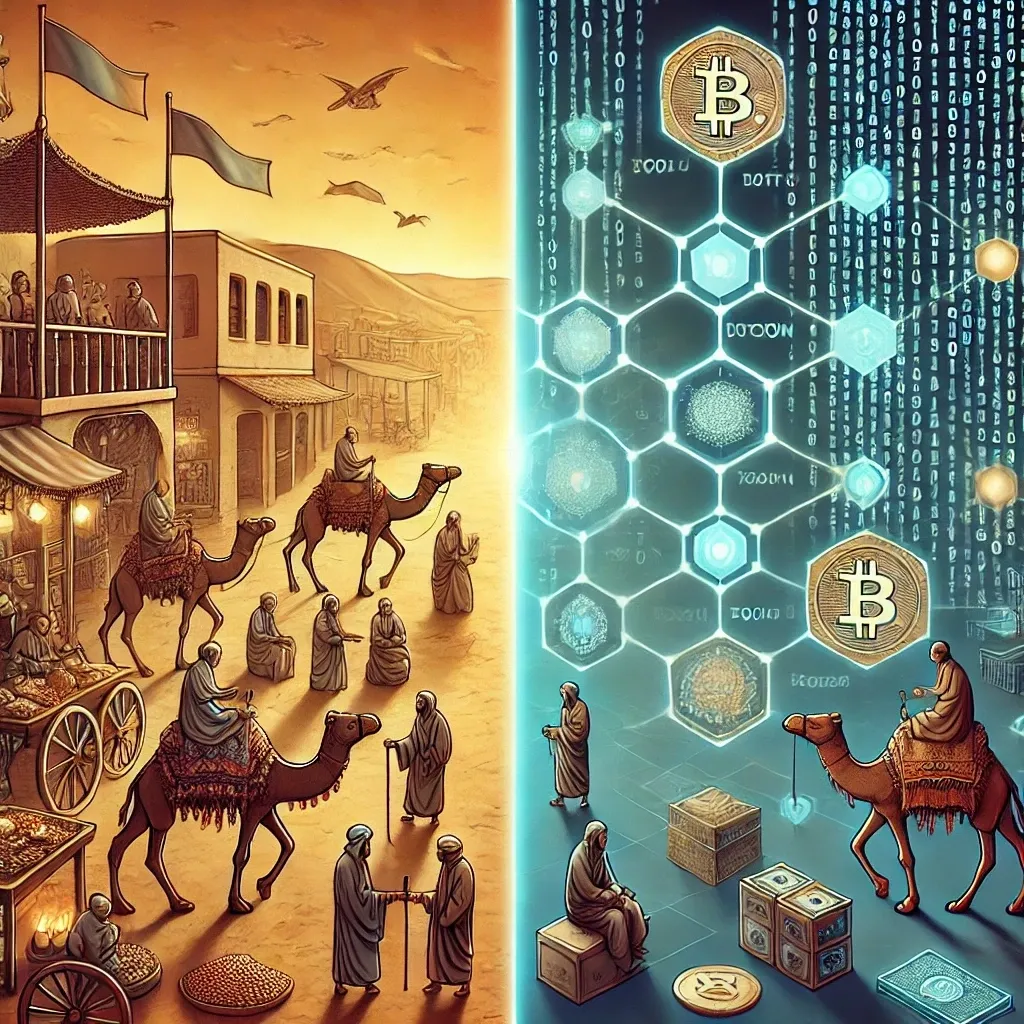
Hawala: An Ancient Financial System and Its Modern Relevance
Hawala, an ancient system of money transfer, predates modern banking by centuries. Often described as a “trust-based” mechanism, it has been a cornerstone of financial transactions in the Middle East, South Asia, and beyond. Its decentralized and informal structure makes it a fascinating precursor to contemporary innovations like Bitcoin and blockchain technology. This article explores the origins, mechanics, socio-economic significance, and legal implications of hawala, while drawing parallels to modern decentralized systems.
1. The Origins of Hawala
The term “hawala” is derived from the Arabic word for “transfer” or “trust.” Historical records trace its origins back to the early Islamic era, around the 8th century, when it emerged as a solution to the risks associated with carrying large sums of money across long distances. Merchants traveling along trade routes, such as the Silk Road, relied on hawala to avoid theft and ensure secure financial transactions.
In its early form, hawala provided a mechanism for transferring value without the physical movement of currency. This made it especially valuable in regions lacking robust banking infrastructure. The system quickly spread throughout the Islamic world and later became integral to the economies of South Asia, the Middle East, and North Africa.
2. How Hawala Works
Hawala operates as an informal value transfer system based on a network of brokers, known as “hawaladars.” These brokers facilitate transactions through trust and personal relationships rather than formal legal agreements. Here’s how a typical hawala transaction works:
Sender’s Step: A person (Sender) approaches a local hawaladar and gives them a sum of money. The hawaladar records the transaction details and provides a code or verbal agreement to the Sender.
Transfer Communication: The local hawaladar contacts a counterpart in the recipient’s location, providing the transaction details and the agreed code.
Recipient’s Step: The counterpart hawaladar pays the recipient the equivalent amount in local currency after verifying the code or details.
Settlement: The hawaladars settle their accounts later, often through trade or other financial mechanisms.
This system bypasses formal banking channels, making it quick, cost-effective, and accessible to individuals in remote or underbanked areas.
3. The Key Features of Hawala
Hawala stands out due to its simplicity, efficiency, and reliance on trust. Its core features include:
Decentralization: Hawala operates without a central authority or regulatory body. Each hawaladar is an independent operator within a larger informal network.
Trust-Based: The system hinges on personal trust between hawaladars and their clients. Reputation is crucial, as breaches of trust can lead to exclusion from the network.
Anonymity: Transactions are private and rarely documented, leaving little to no paper trail.
Low Cost: Fees for hawala transactions are typically lower than those charged by formal banking institutions or money transfer services.
Global Reach: Hawala’s network spans continents, making it a preferred choice for cross-border remittances.
4. Hawala’s Socio-Economic Role
Hawala has played a vital role in addressing financial inclusion, particularly in regions with limited banking infrastructure. Its socio-economic contributions include:
Remittances: Migrant workers often use hawala to send money home, especially when traditional banking systems are slow or inaccessible.
Disaster Relief: In conflict zones or areas affected by natural disasters, hawala provides a reliable means of transferring funds when formal channels are disrupted.
Support for Informal Economies: Hawala aligns with the needs of informal economies, which dominate many developing countries.
5. The Legal and Regulatory Challenges of Hawala
Hawala’s anonymity and lack of documentation have drawn scrutiny from governments and international organizations. Critics argue that its unregulated nature makes it vulnerable to misuse for money laundering, tax evasion, and terrorist financing.
Key regulatory challenges include:
Lack of Transparency: The absence of formal records makes it difficult to track transactions and identify potential misuse.
Cross-Border Monitoring: Hawala transactions often cross international borders, complicating efforts to enforce regulations.
Conflict with Banking Systems: Governments and banks view hawala as a competitor to formal financial systems, leading to efforts to suppress or regulate it.
Despite these challenges, hawala remains resilient due to its deep cultural and economic roots in many communities.
6. Hawala vs. Modern Decentralized Systems
Hawala shares striking similarities with modern decentralized financial systems like Bitcoin, though the two operate on fundamentally different principles. Key comparisons include:
Decentralization:
Hawala: Decentralized through a network of independent hawaladars.
Bitcoin: Decentralized through a blockchain maintained by a global network of nodes.
Trust Mechanism:
Hawala: Relies on interpersonal trust and reputation.
Bitcoin: Eliminates the need for trust through cryptographic algorithms and consensus mechanisms.
Transparency:
Hawala: Transactions are opaque and undocumented.
Bitcoin: Transactions are recorded on a public blockchain, providing transparency with pseudonymity.
Accessibility:
Both systems provide financial access to underserved populations but use different methodologies.
7. The Cultural and Historical Significance of Hawala
Hawala is more than just a financial system; it is a cultural institution deeply embedded in the history of trade and commerce. Its endurance over centuries reflects its adaptability and the trust it inspires among users. In many communities, hawala is not just a practical tool but a symbol of mutual reliance and social cohesion.
8. The Future of Hawala in a Digital Age
As the world moves toward digital and blockchain-based financial systems, hawala faces both challenges and opportunities. On one hand, increasing regulation and digitalization threaten its traditional form. On the other hand, hawala’s principles of decentralization and trust could inspire innovations in the fintech space.
Potential developments include:
Integration with Digital Platforms: Hybrid systems combining hawala’s trust networks with digital payment platforms could emerge.
Blockchain Applications: Blockchain technology could be used to enhance transparency and efficiency in hawala-like systems while preserving decentralization.
9. Ethical and Practical Considerations
While hawala serves a legitimate purpose for many, its potential misuse raises ethical questions. Policymakers must balance the need for regulation with respect for cultural practices and the financial needs of marginalized communities.
10. Conclusion
Hawala is a remarkable testament to the enduring power of trust-based financial systems. Its simplicity, efficiency, and resilience have allowed it to thrive for centuries, even in the face of legal and technological challenges. As we navigate the future of decentralized finance, hawala’s legacy offers valuable lessons about the interplay of trust, innovation, and cultural heritage.
By understanding hawala’s historical and modern significance, we can appreciate its unique place in the global financial landscape and its potential to shape the future of money transfer systems.
Leave a Reply