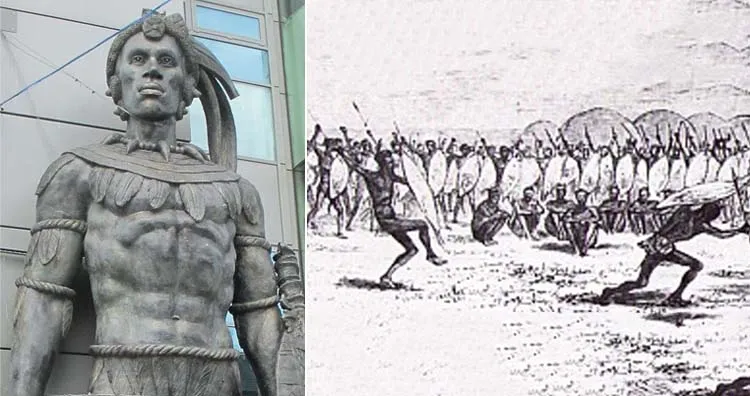
Shaka Zulu: The Grief-Stricken King and His Brutal Response to His Mother’s Death
Shaka Zulu is one of the most renowned and controversial figures in African history. As the leader of the Zulu Kingdom in the early 19th century, he is credited with transforming a small Zulu clan into a powerful military empire in southeastern Africa. His innovations in warfare and military organization are still studied today. However, his reign was also marked by episodes of extreme violence, particularly in response to personal and political events. One of the most infamous events occurred in 1827, after the death of Shaka’s mother, Nandi, when his intense grief drove him to order the execution of thousands of his people, including pregnant women, their husbands, and anyone deemed insufficiently grief-stricken.
Shaka’s actions during this period are often seen as evidence of how his deep sorrow hijacked his mental state, leading to a reign of terror marked by irrational and brutal decrees. In addition to the mass killings, Shaka ordered the slaughter of cows so that their calves would suffer, symbolically reflecting his own pain at losing his mother. This article will explore the background of Shaka Zulu, his reaction to Nandi’s death, and the broader implications of his leadership during one of the most tumultuous periods in Zulu history.
Shaka Zulu: The Rise of a Military Genius
Born around 1787, Shaka was the illegitimate son of Senzangakhona, a Zulu chief, and Nandi, a woman of the Langeni tribe. His early years were marked by hardship, as both he and his mother were shunned and ostracized due to his illegitimate birth. This difficult childhood had a profound impact on Shaka, shaping his character and fueling his ambition to rise above his circumstances.
Shaka’s military career began when he served under the Mthethwa chief Dingiswayo, who recognized Shaka’s exceptional talent as a warrior and leader. After Dingiswayo’s death, Shaka took control of the Zulu clan and began a series of military campaigns that would transform the Zulu Kingdom into one of the most powerful entities in southern Africa. Shaka is best known for his military innovations, including the introduction of the iklwa, a shorter stabbing spear, and the development of the “bullhorn” formation, a highly effective military tactic that allowed his forces to encircle and overwhelm their enemies.
By the 1820s, Shaka had established a formidable Zulu empire, with a well-organized and disciplined army. His rule was characterized by both strategic brilliance and ruthless violence. Shaka’s conquests brought many neighboring tribes under his control, and those who resisted were often met with brutal retribution.
The Death of Nandi and Shaka’s Descent into Madness
Shaka was deeply devoted to his mother, Nandi, and her influence on him was profound. Their close bond was a defining feature of Shaka’s life, and he often credited her with providing him the strength and motivation to rise to power. When Nandi fell ill and died in 1827, Shaka was overwhelmed with grief. Her death shattered him emotionally, and his response was one of extreme mourning and irrational decrees that would plunge the Zulu Kingdom into chaos.
In his grief, Shaka ordered a year of mourning throughout the Zulu Kingdom. This period of mourning was to be marked by extraordinary and brutal measures. Shaka declared that no crops were to be planted during this time, which would have devastating consequences for the food supply. He also banned the consumption of milk, a staple of the Zulu diet, as a symbolic gesture of deprivation. However, these measures paled in comparison to the violent orders that Shaka issued next.
According to historical accounts, Shaka ordered the execution of thousands of his subjects, including pregnant women and their husbands. Pregnant women were specifically targeted because Shaka believed that they should not give birth while the kingdom was in mourning. Entire families were wiped out as a result of these decrees, and any person who was deemed insufficiently grief-stricken over Nandi’s death faced execution. The executions were carried out en masse, with Shaka’s warriors killing men, women, and children without mercy.
In addition to these killings, Shaka ordered that cows be slaughtered so that their calves would suffer the loss of their mothers, symbolizing Shaka’s own deep emotional pain. This act demonstrated the extent to which Shaka’s grief had clouded his judgment and driven him to irrational acts of cruelty.
The Aftermath: Shaka’s Decline and Assassination
The reign of terror following Nandi’s death alienated many of Shaka’s subjects and advisors. His extreme actions not only decimated his population but also created widespread resentment among the Zulu people and his inner circle. The execution of innocent people and the destruction of livestock and food sources destabilized the kingdom, creating a sense of fear and uncertainty.
Shaka’s mental state deteriorated further in the wake of these events. He became increasingly paranoid and suspicious of those around him, fearing betrayal and rebellion. His once-loyal generals and advisors grew disillusioned with his leadership, recognizing that his grief-fueled tyranny was endangering the stability of the kingdom.
In 1828, just a year after Nandi’s death, Shaka was assassinated by his half-brothers Dingane and Mhlangana, who had grown weary of his erratic and violent rule. With the help of trusted advisors, they launched a coup, killing Shaka and seizing power. Dingane succeeded Shaka as the leader of the Zulu Kingdom, though his reign would also be marked by violence and instability.
Legacy: Shaka Zulu’s Dual Reputation
Shaka Zulu’s legacy is complex and multifaceted. On one hand, he is remembered as a military genius and the architect of the Zulu Kingdom’s rise to power. His innovations in warfare and his ability to unite the Zulu people under a centralized state earned him a place as one of Africa’s most powerful and influential leaders. Shaka’s impact on southern African history is undeniable, and he is often celebrated as a national hero in modern South Africa.
However, Shaka’s reign was also marked by extreme violence, both in his conquests and in his treatment of his own people. The events following Nandi’s death highlight the darker side of his rule—a period of madness in which grief overwhelmed his sense of reason and led to the deaths of thousands. His irrational decrees, mass executions, and symbolic acts of cruelty, such as the slaughtering of cows, are remembered as a tragic chapter in the history of the Zulu Kingdom.
Shaka’s reign of terror in 1827 serves as a stark reminder of the dangers of unchecked power and the ways in which personal grief can manifest in destructive ways when held by a leader with absolute control. His actions during this time not only devastated his people but also contributed to his downfall, as his erratic behavior eroded the loyalty of those around him and ultimately led to his assassination.
Conclusion: A Tragic Episode in Shaka’s Reign
Shaka Zulu’s reaction to the death of his mother, Nandi, was one of profound grief that led to one of the bloodiest and most irrational episodes of his rule. His decision to kill pregnant women, their husbands, and others who were deemed insufficiently grief-stricken, as well as his symbolic slaughtering of cows, reflected a descent into madness that shocked both his subjects and his advisors.
Though Shaka remains a towering figure in African history, his legacy is forever tainted by the terror he unleashed in his final years. His story serves as a cautionary tale about the potential for personal emotions—when coupled with unchecked power—to spiral into devastating consequences for an entire nation.
Leave a Reply