The Cambodian Genocide: The Brutal Regime of Pol Pot
The Cambodian Genocide: The Brutal Regime of Pol Pot and the Khmer Rouge (1975–1979)
From 1975 to 1979, Cambodia was ruled by one of the most brutal regimes in modern history—the Communist government of the Khmer Rouge, led by Pol Pot. During this four-year period, the country experienced a genocide that resulted in the deaths of at least 1.4 million Cambodians, although some estimates place the death toll even higher, at closer to 2 million. The regime’s policies of forced labor, widespread executions, food scarcity, and the spread of deadly diseases decimated the population, leaving a dark and painful legacy that haunts Cambodia to this day.
Under Pol Pot’s leadership, the Khmer Rouge sought to radically transform Cambodian society into a self-sufficient, agrarian utopia. This vision was inspired by Maoist communism, and the regime aimed to eliminate all aspects of modern urban life, capitalist influence, and Western ideology. In pursuit of this ideological goal, the Khmer Rouge targeted intellectuals, professionals, ethnic minorities, religious groups, and anyone suspected of disloyalty. The result was one of the most catastrophic human rights atrocities of the 20th century.
The Rise of the Khmer Rouge and Pol Pot’s Vision
Pol Pot, born Saloth Sar, rose to power as the leader of the Khmer Rouge, a communist guerrilla movement that had been fighting against Cambodia’s government since the late 1960s. In April 1975, after years of civil war, the Khmer Rouge captured the capital city of Phnom Penh and overthrew the government of Lon Nol, marking the beginning of their rule.
Pol Pot and the Khmer Rouge immediately set about implementing their radical vision of a classless, agrarian society. Inspired by Mao Zedong’s Cultural Revolution in China, Pol Pot believed that Cambodia could achieve true communism by completely abolishing urban life, private property, and capitalism. Cities were seen as corrupting influences, and their inhabitants were deemed enemies of the revolution.
One of the first actions of the Khmer Rouge was to evacuate the entire population of Phnom Penh and other cities, forcibly relocating millions of people to the countryside. The regime declared that Cambodia would be rebuilt as a rural, agrarian state, with the majority of the population working as peasants in communal farms. Schools, hospitals, businesses, and factories were shut down, and currency was abolished. The Khmer Rouge referred to this as Year Zero, a symbolic break with the past and the beginning of a new era.
Forced Labor and Food Scarcity
The Khmer Rouge regime implemented harsh policies of forced labor, requiring all citizens to work long hours in the fields under brutal conditions. The regime collectivized agriculture, creating large communal farms where the population was forced to work from dawn until dusk. People were given meager food rations and were often required to perform backbreaking tasks, such as building irrigation systems and rice paddies by hand.
The combination of overwork, malnutrition, and inadequate medical care led to widespread starvation and disease. Cambodia’s infrastructure had been devastated by years of civil war, and the regime’s agricultural policies were disastrously mismanaged. Crops failed, and food production plummeted, exacerbating the crisis. Even when food was available, the Khmer Rouge often hoarded it for themselves or exported it to fund the regime.
The consequences were catastrophic. Hundreds of thousands of Cambodians died from starvation, exhaustion, and diseases such as malaria and dysentery. The death toll from famine and illness was compounded by the regime’s brutal response to those who were too weak or ill to work. Those deemed “lazy” or “unproductive” were often executed or left to die.
The Persecution and Execution of “Enemies” of the State
Pol Pot and the Khmer Rouge believed that the revolution could only succeed if all potential threats were eliminated. As a result, they launched a campaign of terror against anyone suspected of disloyalty or ideological deviation. The regime divided society into two broad categories: the “base people”, who were rural peasants and considered loyal to the revolution, and the “new people”, who were urban dwellers, intellectuals, professionals, and those associated with the previous government. The “new people” were seen as enemies of the state and were targeted for persecution.
The Khmer Rouge identified and executed anyone they deemed a potential “counter-revolutionary.” This included intellectuals, teachers, doctors, monks, and former government officials. Simply wearing glasses, knowing a foreign language, or having any association with Western culture could result in death, as these were seen as signs of being influenced by the old capitalist regime.
The regime also encouraged paranoia within its own ranks. Khmer Rouge officials were expected to identify and execute suspected traitors, even within their own families. Those who failed to denounce enough “counter-revolutionaries” were themselves accused of disloyalty and executed. This atmosphere of fear and suspicion led to mass purges, with thousands of loyal citizens, including Khmer Rouge cadres, being killed because they were suspected of harboring anti-revolutionary sentiments.
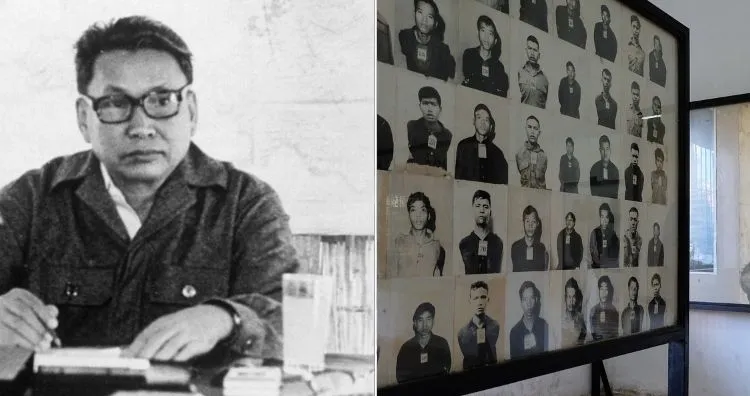
One of the most notorious sites of these executions was S-21, also known as Tuol Sleng, a former high school in Phnom Penh that had been converted into a secret prison. Thousands of people, including men, women, and children, were detained at S-21, tortured, and forced to confess to crimes they did not commit before being executed. Of the approximately 17,000 people imprisoned at S-21, only a handful survived.
The Killing Fields: Mass Executions and Genocide
The violence and terror inflicted by the Khmer Rouge were not limited to political dissidents or intellectuals. The regime also carried out ethnic cleansing against minority groups such as the Cham Muslims, ethnic Vietnamese, and Chinese Cambodians. Religious groups, particularly Buddhist monks, were persecuted, and most religious practices were banned. Pol Pot’s vision of an ethnically homogenous, communist Cambodia led to the systematic extermination of these groups.
The Khmer Rouge carried out mass executions across the country, often in isolated rural areas known as the Killing Fields. Prisoners were taken to these remote locations, where they were executed en masse and buried in shallow graves. Bullets were considered too expensive, so many victims were beaten to death with blunt instruments, hammers, or agricultural tools. Some victims were even killed by being buried alive.
The exact number of people executed during the Khmer Rouge regime is difficult to determine, but estimates suggest that between 1.4 million and 2 million Cambodians—nearly a quarter of the country’s population at the time—died as a result of execution, starvation, disease, and forced labor. The regime’s brutality was systematic, and its impact on Cambodian society was devastating.
The Fall of the Khmer Rouge and the Aftermath
The Khmer Rouge regime came to an end in January 1979, when Vietnamese forces invaded Cambodia and overthrew Pol Pot’s government. The invasion was prompted by rising tensions between Cambodia and Vietnam, including border skirmishes and massacres of Vietnamese civilians by the Khmer Rouge. When Vietnamese troops entered Phnom Penh, they found a country in ruins, with mass graves and killing fields scattered across the countryside.
Pol Pot and the remnants of the Khmer Rouge retreated into the jungles near the Thai border, where they continued to wage a guerrilla war against the new government for several years. Pol Pot remained the de facto leader of the Khmer Rouge until his death in 1998, but the movement never regained power.
In the aftermath of the Khmer Rouge’s fall, Cambodia struggled to rebuild. The country was left traumatized by the genocide, and its infrastructure, economy, and social fabric had been shattered. Many survivors were left to cope with the physical and psychological scars of the atrocities they had endured. Efforts to bring justice to the victims of the Khmer Rouge have been slow and difficult, largely due to political complexities and the challenges of prosecuting those responsible.
In 2006, the Extraordinary Chambers in the Courts of Cambodia (ECCC), commonly referred to as the Khmer Rouge Tribunal, was established to prosecute senior leaders of the Khmer Rouge for crimes against humanity. Several key figures, including Nuon Chea, the regime’s chief ideologue, and Khieu Samphan, its head of state, have been convicted of war crimes and genocide. However, many other perpetrators have escaped justice, and for some survivors, the trauma of the Khmer Rouge era remains unresolved.
The Legacy of the Khmer Rouge
The legacy of Pol Pot’s regime continues to haunt Cambodia. The Khmer Rouge period not only led to the deaths of millions but also left deep scars on the nation’s collective psyche. The physical destruction of the country’s infrastructure and the loss of an entire generation of intellectuals, artists, and professionals has had long-term consequences for Cambodia’s development.
Moreover, the psychological trauma experienced by survivors has had a profound impact on the country’s social and political fabric. The culture of fear, mistrust, and paranoia that characterized the Khmer Rouge years has left many Cambodians wary of political engagement. For decades, discussions about the atrocities committed by the Khmer Rouge were suppressed, and it has only been in recent years that open conversations about the genocide have begun to take place.
Despite these challenges, Cambodia has made progress in rebuilding and healing from its dark past. Monuments such as the Choeung Ek Killing Fields and the Tuol Sleng Genocide Museum serve as reminders of the atrocities and as sites for collective mourning and remembrance. Schools now teach the history of the Khmer Rouge, ensuring that future generations learn from the horrors of the past.
Conclusion: The Cambodian Genocide as a Warning from History
The Khmer Rouge’s reign of terror under Pol Pot from 1975 to 1979 remains one of the most horrific episodes of state-sponsored mass murder in modern history. The regime’s radical pursuit of a communist agrarian utopia resulted in the deaths of at least 1.4 million Cambodians, though the true toll may never be fully known. Pol Pot’s government, driven by a mix of ideological extremism, paranoia, and xenophobia, systematically exterminated vast numbers of its own people through forced labor, starvation, disease, and execution.
The Cambodian genocide serves as a grim reminder of the dangers of authoritarianism, unchecked power, and ideological fanaticism. It highlights the capacity of a regime to dehumanize its citizens in the name of an ideological vision and the horrific consequences that can follow when a government turns on its own people.
Today, as Cambodia continues to rebuild from the devastation of the Khmer Rouge years, the memory of the genocide remains a source of both pain and resilience. It stands as a stark warning to the world of the catastrophic human cost of totalitarianism and the importance of vigilance in the protection of human rights.
Leave a Reply