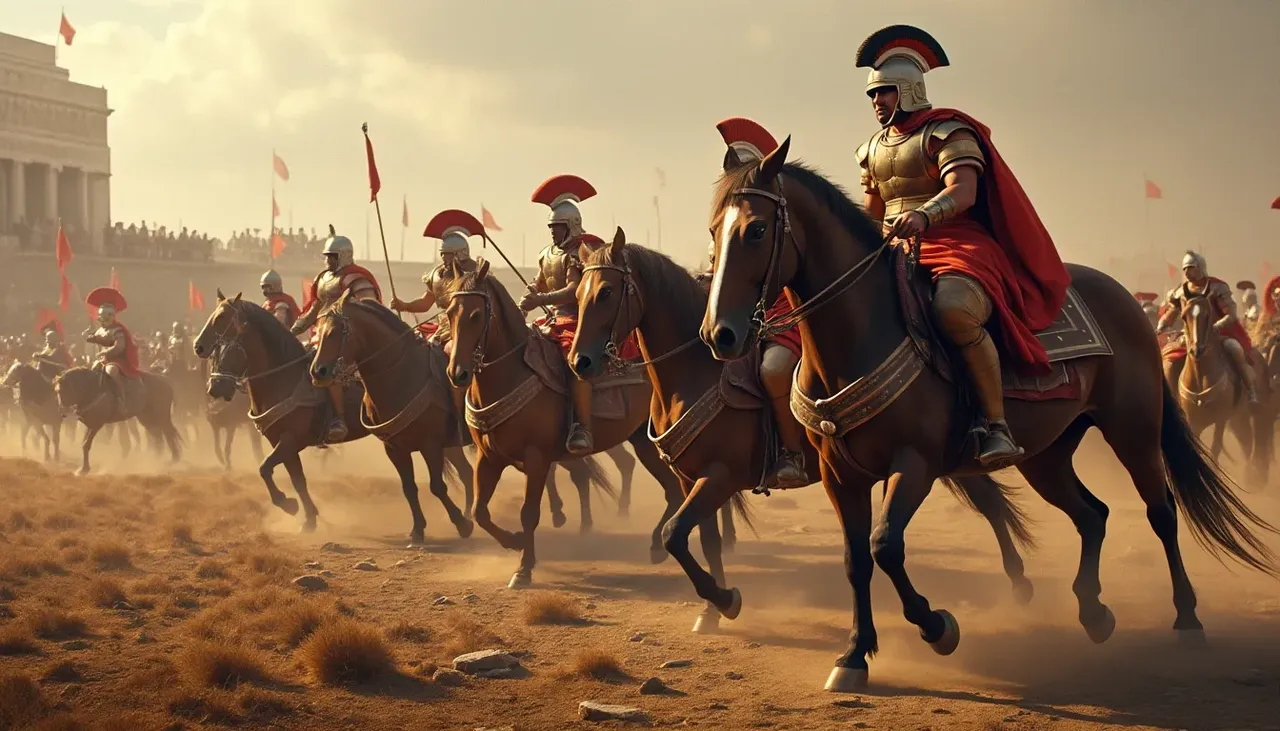
The Connection Between War Horses and Trains: A Historical Legacy in Railroad Gauge
The history of warfare and transportation is full of fascinating connections, one of the most enduring being the relationship between war horses and the width of railroad tracks. While it may seem counterintuitive, the modern railroad gauge—the distance between two rails—is deeply rooted in the dimensions of war horses, particularly their width. This seemingly small detail has had an outsized impact on the development of global transportation networks, leaving a legacy that stretches from the Roman Empire to modern high-speed railways.
The Origins of War Horses and Wagon Width
To understand the connection between war horses and railroad tracks, we must first explore the use of horses in transportation and warfare throughout history. War horses, bred for strength and endurance, were larger and wider than typical riding horses. Their size was not just a matter of breeding for power but also a practical adaptation to the demands of carrying heavily armored knights or pulling massive loads, whether chariots in battle or carts of military supplies.
In ancient times, especially during the Roman Empire, horses were integral to military logistics. Roman chariots, and later carts and wagons, were designed to be drawn by two horses abreast. These horses needed space to move efficiently, meaning that the axle of the carts had to be spaced wide enough to accommodate them. The result was a wagon design that could comfortably fit the rear ends of two war horses, which set a standard width of about 4 to 5 feet.
This dimension wasn’t just a matter of convenience; it became essential for maintaining the durability of the roads. Roman roads, renowned for their durability, had deep grooves worn into them by the repeated passage of horse-drawn vehicles. To avoid damaging the wheels or axles of carts, they were all built to conform to this standard width, ensuring that they could fit neatly into the ruts already established by other vehicles. Over time, this axle width became standard across the Roman Empire and, eventually, much of Europe.
The Transition from Carts to Railroads
Fast forward to the early 19th century, and the Industrial Revolution was transforming Europe and North America. Steam engines had been developed, and railways were emerging as a powerful new mode of transportation. However, early railroads didn’t come into existence in a vacuum—they evolved from existing forms of transportation. The first railroads were essentially an adaptation of mining cart systems, where horse-drawn carts ran on wooden or iron tracks to transport coal from mines to ports.
When these early railroads were built, the engineers responsible for their design were the same people who had been constructing roads and wagons for centuries. They were familiar with the existing standard for axle width, which was dictated by the need to accommodate two horses side by side. As a result, when the first steam locomotives were designed, they were built to run on tracks spaced at roughly the same distance as the wheels of horse-drawn wagons: 4 feet 8.5 inches.
This gauge became the standard for railroads not because of any inherent engineering superiority, but simply because it was what had always been done. The width of two war horses, a practical solution to the demands of ancient chariot and cart transportation, became the foundation upon which a new age of transportation was built.
George Stephenson and the Standardization of Rail Gauge
One of the key figures in the development of modern railroads was George Stephenson, a British engineer who is often called the “Father of Railways.” Stephenson played a pivotal role in building the world’s first modern railway, the Stockton and Darlington Railway, and later the famous Liverpool and Manchester Railway. When Stephenson designed his locomotives and tracks, he chose the same gauge that was already in use for horse-drawn carts and wagons: 4 feet 8.5 inches.
Stephenson’s choice of this gauge had far-reaching consequences. As the British railway network expanded, the 4 feet 8.5 inches gauge became the standard across the country. Britain’s global influence during the 19th century meant that this standard gauge was adopted by many of its colonies and other nations looking to build their own rail networks. Today, approximately 60% of the world’s railways use this “standard gauge.”
Why 4 Feet 8.5 Inches?
At first glance, 4 feet 8.5 inches seems like an oddly specific number for something as important as a global transportation network. But this precise measurement is rooted in ancient practicalities. The width of two war horses pulling a cart determined the spacing of the axles. That spacing was then carried over to the design of roads, carts, and ultimately railroads.
War horses, especially those bred for battle, were not just ordinary horses. They were larger, wider, and stronger, capable of carrying heavily armored knights or pulling massive loads. This width allowed them to operate efficiently in military formations and logistical operations, providing stability and power. When two horses were hitched to a chariot or wagon, the space needed between them naturally influenced the width of the vehicles they pulled.
By the time railroads were being developed, the dimensions of horse-drawn carts had been standardized for centuries. The width of two war horses—translated into the spacing of wagon wheels—became the practical measurement for early railway tracks. In this way, the legacy of war horses continued into the industrial age, shaping one of the most significant technological advancements of the 19th century.
The Influence of Railroads on Warfare
The advent of railroads did not immediately replace horses in military operations, but it significantly changed the logistics of warfare. Railways allowed armies to move troops, supplies, and equipment over long distances far more quickly than ever before. Trains could carry more weight than the largest teams of horses, and they could travel at speeds that horses simply couldn’t match over extended distances.
Despite this, horses remained essential in many aspects of military campaigns. While trains could transport soldiers and supplies to the front lines, horses were still needed in the trenches, on battlefields, and in rugged terrain where railways couldn’t reach. The combination of trains for long-distance logistics and horses for local mobility created a powerful synergy in military operations.
Even during the American Civil War, which is often seen as a transitional period for military logistics, horses played a crucial role alongside trains. While railroads transported vast quantities of supplies, horses were still needed to haul cannons, ammunition, and food across shorter, less accessible distances.
From War Horses to Tanks: The End of an Era
The relationship between horses and trains continued into the early 20th century, but by World War I, mechanization was rapidly overtaking both. The development of motor vehicles and tanks, which could carry even heavier loads and operate independently of railways, marked the beginning of the end for horses as a primary means of military transportation.
However, the legacy of war horses lives on in the tracks that trains still run on today. The standard gauge of 4 feet 8.5 inches, which was originally based on the width of two war horses, remains the most common gauge for railways around the world. Even as trains evolved into high-speed systems and electric rail networks, the foundational measurement of two horses standing side by side continues to influence modern transportation.
The Legacy of the War Horse
The war horse, once a symbol of military might and power, has left a lasting imprint on the world’s infrastructure. While the age of cavalry charges and horse-drawn artillery is long gone, the influence of the war horse can still be felt every time a train rumbles down a track.
In a world of rapid technological advancement, it is easy to forget that some of the most modern innovations are built on the foundations of ancient practices. The relationship between war horses and trains serves as a reminder that history often shapes the future in unexpected ways. The width of a Roman chariot, designed to fit two sturdy war horses, has echoed through the centuries to become the standard measurement for one of the most important transportation systems in the world.
In the end, the story of the railroad gauge is not just a story of engineering, but a story of how practical decisions made in ancient warfare and logistics continue to influence our lives in the modern age. War horses, with their strength, width, and enduring legacy, have left a footprint that reaches far beyond the battlefield—right onto the tracks of history.
Leave a Reply