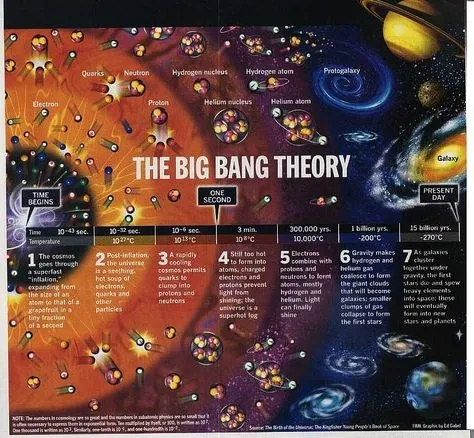
The Big Bang Theory is the leading explanation for our Universe
The Big Bang Theory is the leading explanation for how the universe began, proposing that the universe started as a singularity and expanded over billions of years into what we observe today. A detailed 12-page article would cover the historical development of the theory, the scientific evidence supporting it, key concepts in cosmology, and the challenges and implications for our understanding of the universe.
Here’s a structured and expanded outline for the article:
Page 1: Introduction
Overview of the Big Bang Theory: Introduce the Big Bang Theory as the prevailing cosmological model explaining the origin and expansion of the universe. It posits that the universe began as a singularity approximately 13.8 billion years ago and has been expanding ever since.
Purpose of the article: Present the goal of the article, which is to explore the scientific background of the Big Bang Theory, its evidence, key principles, and the ongoing challenges in cosmology.
The importance of the theory in modern science: Highlight how the Big Bang Theory is central to our understanding of the universe, linking cosmology, physics, and astronomy.
Page 2: Historical Development of the Big Bang Theory
Early ideas about the universe: Begin with ancient and early modern views of the universe, including geocentric models and steady-state theories, which held that the universe was static and eternal.
Einstein’s General Theory of Relativity (1915): Discuss how Einstein’s equations of general relativity provided a framework for understanding the gravitational dynamics of the universe. Einstein initially introduced the cosmological constant to maintain a static universe but later referred to this as his “biggest blunder” when evidence showed an expanding universe.
Georges Lemaître and the “Primeval Atom”: Introduce Belgian physicist Georges Lemaître, who in 1927 proposed the idea of a “primeval atom” or “cosmic egg” that expanded to create the universe, laying the groundwork for the Big Bang Theory.
Page 3: Hubble’s Discovery of the Expanding Universe
Edwin Hubble’s observations: Discuss Hubble’s pivotal 1929 discovery that galaxies are moving away from each other, which provided strong evidence for the expansion of the universe. His observations of redshift in distant galaxies supported the idea that space itself is expanding.
Hubble’s Law: Explain Hubble’s Law, which describes the relationship between the distance of galaxies and their velocity, further confirming the idea of an expanding universe. This discovery was a cornerstone of the Big Bang Theory.
Shift from a static to a dynamic universe: Explore how Hubble’s findings shifted the scientific consensus from a static universe to an expanding one, supporting the idea that the universe had a beginning.
Page 4: Key Concepts of the Big Bang Theory
Singularity: Explain the concept of a singularity, the initial state of the universe where all matter, energy, space, and time were concentrated in an infinitely small point.
Expansion of space: Describe how the Big Bang was not an explosion of matter into space but rather an expansion of space itself, stretching the fabric of the universe.
Cosmic inflation: Introduce the concept of cosmic inflation, a rapid expansion of the universe that occurred fractions of a second after the Big Bang. Alan Guth’s inflation theory explains how the universe grew exponentially during this very early stage.
Timeline of the Big Bang: Outline the major epochs of the universe’s history, from the Planck epoch, the inflationary epoch, to the formation of matter and the cosmic microwave background (CMB).
Page 5: The Cosmic Microwave Background (CMB)
Discovery of the CMB: Discuss the accidental discovery of the CMB in 1965 by Arno Penzias and Robert Wilson, which provided critical evidence for the Big Bang Theory. The CMB is the faint afterglow of the Big Bang, a relic radiation that fills the universe.
What the CMB tells us: Explain how the CMB represents the thermal radiation from when the universe became transparent, about 380,000 years after the Big Bang. It is a snapshot of the universe in its infancy, providing a wealth of information about the early universe.
COBE and WMAP missions: Explore how subsequent experiments like the Cosmic Background Explorer (COBE) and the Wilkinson Microwave Anisotropy Probe (WMAP) have provided high-resolution maps of the CMB, revealing temperature fluctuations that correspond to the formation of early cosmic structures.
Page 6: Nucleosynthesis and the Formation of Elements
Big Bang Nucleosynthesis: Discuss the process of Big Bang nucleosynthesis, which occurred within the first few minutes of the universe. This is when the first atomic nuclei—hydrogen, helium, and trace amounts of lithium—formed.
Formation of heavier elements: Explain how heavier elements, such as carbon, oxygen, and iron, were not formed during the Big Bang but through stellar nucleosynthesis in stars billions of years later. This process highlights the connection between the early universe and the formation of the cosmos we see today.
Predictions of element abundances: Describe how the Big Bang Theory accurately predicts the relative abundances of light elements in the universe, which align with observational data.
Page 7: The Expansion of the Universe
The expanding universe: Revisit the concept of the expanding universe, focusing on how galaxies are moving apart from each other as space itself stretches. Discuss how this expansion is accelerating, a discovery that came in the late 1990s.
Dark energy and the accelerating expansion: Introduce the concept of dark energy, the mysterious force driving the accelerated expansion of the universe. This discovery led to significant revisions in the understanding of the universe’s future and the ultimate fate of the cosmos.
Hubble constant and its implications: Explore the significance of the Hubble constant, the rate at which the universe is expanding, and the ongoing challenges in determining its precise value. Discrepancies between different measurements of the Hubble constant are a major puzzle in modern cosmology.
Page 8: Dark Matter and Dark Energy
What is dark matter?: Discuss the concept of dark matter, an invisible substance that makes up about 27% of the universe’s mass-energy content. Dark matter does not emit light or energy but is inferred from its gravitational effects on galaxies and galaxy clusters.
Dark energy and its dominance: Explain dark energy, the mysterious force that constitutes about 68% of the universe’s total energy and is responsible for the accelerated expansion of the universe. Dark energy remains one of the biggest enigmas in cosmology.
The role of dark matter in structure formation: Discuss how dark matter plays a crucial role in the formation of galaxies and large-scale structures in the universe by providing the gravitational “scaffolding” needed to hold cosmic structures together.
Page 9: Alternative Theories to the Big Bang
Steady-State Theory: Introduce the Steady-State Theory, an alternative to the Big Bang, which posits that the universe has no beginning or end and is constantly creating new matter as it expands. The discovery of the CMB effectively disproved this theory.
Oscillating Universe Model: Explore the oscillating universe model, which suggests that the universe undergoes endless cycles of expansion and contraction, potentially giving rise to multiple “Big Bangs.”
Multiverse Theory: Discuss the multiverse hypothesis, which proposes the existence of multiple, perhaps infinite, universes beyond our own. This idea stems from certain interpretations of quantum mechanics and cosmological inflation.
Challenges to the Big Bang Theory: Address some of the scientific challenges to the Big Bang Theory, such as the flatness problem and horizon problem, and how inflation theory helps resolve these issues.
Page 10: The Future of the Universe
The fate of the universe: Explore the possible scenarios for the ultimate fate of the universe, depending on the balance between dark energy and gravitational forces. The Big Bang Theory offers several possibilities:
Big Freeze: If the expansion continues indefinitely, the universe may experience a “Big Freeze,” where galaxies drift apart, stars burn out, and the universe cools to near absolute zero.
Big Crunch: If gravity eventually overcomes expansion, the universe could collapse back into a singularity, leading to a “Big Crunch,” essentially reversing the Big Bang.
Big Rip: In some models, dark energy might grow stronger over time, tearing apart galaxies, stars, and even atoms in a scenario called the “Big Rip.”
Role of dark energy in determining the future: Dark energy plays a critical role in shaping the future of the universe, but its true nature remains one of the most significant unsolved mysteries in cosmology.
Page 11: Implications for Cosmology and Philosophy
Philosophical implications of the Big Bang: Discuss how the Big Bang Theory challenges traditional philosophical and theological ideas about the origin and nature of the universe. The concept of a finite beginning to time and space raises profound questions about the nature of existence and the universe’s purpose.
Connection to religious thought: Explore how different religious traditions have interpreted the Big Bang. Some see it as compatible with the idea of a creator, while others view it as a purely scientific explanation of the universe’s origins, separate from religious narratives.
Cosmic evolution and the search for meaning: Consider how the Big Bang Theory has influenced modern thought about humanity’s place in the cosmos. As the universe is understood to have evolved from simple beginnings to complex structures, this raises questions about life, consciousness, and the potential for other forms of life in the universe.
Page 12: Conclusion and Future Research
Summary of the Big Bang Theory: Summarize the key points discussed, including the historical development of the theory, the evidence supporting it (such as cosmic microwave background radiation, nucleosynthesis, and the expanding universe), and the role of dark matter and dark energy.
Open questions and challenges: Highlight the ongoing questions in cosmology, such as the true nature of dark matter and dark energy, the exact value of the Hubble constant, and whether inflation theory fully explains the early moments of the universe.
Future directions in cosmology: Discuss the future of cosmological research, including upcoming space missions (like the James Webb Space Telescope) and experiments that aim to deepen our understanding of the universe’s origins and fate. The quest to understand the Big Bang continues, with many exciting discoveries on the horizon.
This expanded outline provides a comprehensive exploration of the Big Bang Theory, addressing its scientific, philosophical, and historical dimensions. Each section offers an in-depth look at key concepts, evidence, and unresolved questions in cosmology, providing readers with a well-rounded understanding of this cornerstone of modern science.
4o
You said:
expand
ChatGPT said:
ChatGPT
Here’s an expanded version of the 12-page article on the Big Bang Theory. Each section is further developed to provide a more detailed analysis of the theory’s scientific foundations, evidence, key principles, challenges, and implications for our understanding of the universe. The goal is to offer a thorough, comprehensive discussion of one of the most important theories in modern cosmology.
Page 1: Introduction
Overview of the Big Bang Theory: The Big Bang Theory is the most widely accepted explanation of how the universe came into existence. It proposes that the universe began as a singularity—an infinitely small and dense point—about 13.8 billion years ago. From this point, space itself began expanding, and the universe has continued to expand ever since.
Purpose of the article: This article will explore the development of the Big Bang Theory, from its historical roots to modern discoveries. It will also examine the scientific evidence supporting it, key cosmological principles, and the theory’s broader implications for science and philosophy.
Importance of the theory: The Big Bang Theory revolutionized our understanding of the universe, integrating ideas from cosmology, physics, and astronomy. It not only explains the origin of the universe but also provides a framework for understanding the large-scale structure and evolution of the cosmos.
Page 2: Historical Development of the Big Bang Theory
Early ideas about the universe: Before the Big Bang Theory, many believed in a static, eternal universe, a view that dated back to ancient philosophers like Aristotle. In the early 20th century, the prevailing model was the Steady-State Theory, which held that the universe was unchanging and had no beginning or end.
Einstein’s General Theory of Relativity (1915): Einstein’s general theory of relativity fundamentally changed how scientists understood gravity, space, and time. His equations suggested that the universe could not be static; it had to either be expanding or contracting. Einstein introduced the cosmological constant to counter this, ensuring a static universe. However, this was later discarded as observational evidence showed an expanding universe.
Georges Lemaître and the “Primeval Atom”: In 1927, Belgian priest and physicist Georges Lemaître proposed the idea that the universe began from a “primeval atom,” an incredibly dense and hot state, and has been expanding ever since. Lemaître’s idea was a precursor to what would later become the Big Bang Theory, although it was met with skepticism at the time.
Page 3: Hubble’s Discovery of the Expanding Universe
Edwin Hubble’s observations: In 1929, American astronomer Edwin Hubble made a groundbreaking discovery: distant galaxies are moving away from us, and the farther away they are, the faster they seem to be receding. This phenomenon, known as the “redshift,” was evidence that the universe is expanding.
Hubble’s Law: Hubble formulated a relationship, now known as Hubble’s Law, which states that the velocity at which a galaxy is moving away from Earth is proportional to its distance from us. This provided the first strong observational evidence for an expanding universe, a cornerstone of the Big Bang Theory.
Implications of Hubble’s discovery: Hubble’s observations shattered the idea of a static universe. If the universe is expanding, it must have been smaller in the past, supporting Lemaître’s idea of a cosmic beginning. This led to the realization that the universe had a finite age and a specific point of origin.
Page 4: Key Concepts of the Big Bang Theory
Singularity: At the very beginning of the universe, all matter and energy were concentrated in an incredibly hot, dense point known as a singularity. This singularity marked the birth of the universe, but it is not fully understood due to the breakdown of known physical laws at such extreme conditions.
Expansion of space: The Big Bang is often misunderstood as an explosion of matter into empty space. However, it is more accurately described as the expansion of space itself. As space expanded, it carried matter and energy with it, causing galaxies to move apart from each other.
Cosmic inflation: The concept of cosmic inflation, introduced by physicist Alan Guth in the 1980s, posits that in the first tiny fraction of a second after the Big Bang, the universe underwent a period of exponential expansion. This inflationary period explains the large-scale uniformity of the universe and resolves several key problems with earlier Big Bang models.
Timeline of the Big Bang: The Big Bang Theory describes a series of important events: the Planck epoch (when quantum effects dominated), the inflationary period, the formation of elementary particles, the cooling and recombination phase, and the creation of cosmic structures like galaxies and stars.
Page 5: The Cosmic Microwave Background (CMB)
Discovery of the CMB: In 1965, physicists Arno Penzias and Robert Wilson discovered a faint, uniform microwave radiation coming from all directions in space. This radiation, known as the cosmic microwave background (CMB), is the leftover heat from the Big Bang and serves as critical evidence supporting the Big Bang Theory.
What the CMB tells us: The CMB is essentially a snapshot of the universe when it was about 380,000 years old, just after atoms formed, and the universe became transparent. By studying the CMB, scientists can learn about the early conditions of the universe, including its density, temperature, and rate of expansion.
COBE and WMAP missions: The Cosmic Background Explorer (COBE) satellite, launched in 1989, provided the first detailed measurements of the CMB. Later, the Wilkinson Microwave Anisotropy Probe (WMAP), launched in 2001, created a highly accurate map of the temperature fluctuations in the CMB, offering more insights into the early universe and its structure formation.
Page 6: Nucleosynthesis and the Formation of Elements
Big Bang Nucleosynthesis: Big Bang Nucleosynthesis occurred within the first three minutes after the Big Bang, when the universe was hot enough for nuclear reactions to occur. During this time, the first atomic nuclei were formed, predominantly hydrogen, helium, and trace amounts of lithium.
Formation of heavier elements: The Big Bang only produced the lightest elements. Heavier elements, such as carbon, oxygen, and iron, were formed much later inside stars through nuclear fusion and then dispersed into space by supernovae explosions. This process, known as stellar nucleosynthesis, built the chemical diversity of the universe.
Elemental abundances as evidence: One of the great successes of the Big Bang Theory is its ability to predict the relative abundances of light elements in the universe. Observations of hydrogen, helium, and lithium in the cosmos closely match the predictions made by the theory, further validating the model.
Page 7: The Expansion of the Universe
The expanding universe: Since Hubble’s discovery, it has been established that the universe is not only expanding but doing so at an accelerating rate. This expansion means that space between galaxies is stretching, causing them to move away from each other.
Dark energy and the accelerating expansion: In 1998, observations of distant supernovae revealed that the expansion of the universe is accelerating, a discovery that shocked the scientific community. This acceleration is attributed to dark energy, a mysterious force that opposes the pull of gravity.
Hubble constant and its implications: The Hubble constant represents the rate of the universe’s expansion. Determining its precise value is critical for understanding the age and size of the universe. However, there is currently a discrepancy between different measurements of the Hubble constant—one derived from the CMB and another from observing distant supernovae—leading to debates and ongoing research.
Page 8: Dark Matter and Dark Energy
What is dark matter?: Dark matter is a form of matter that does not emit, absorb, or reflect light, making it invisible. However, its gravitational effects can be observed, particularly in the rotation of galaxies and the bending of light around massive objects (gravitational lensing). Dark matter is believed to make up about 27% of the universe’s mass-energy content.
Dark energy and its dominance: Dark energy, a hypothetical form of energy that permeates all of space, is even more enigmatic than dark matter. It is responsible for the accelerated expansion of the universe and is estimated to constitute about 68% of the universe’s total energy. Despite its importance, the exact nature of dark energy remains one of the greatest mysteries in cosmology.
The role of dark matter in structure formation: Dark matter played a critical role in the formation of galaxies and large-scale structures. After the Big Bang, dark matter clumped together under gravity, creating the scaffolding around which ordinary matter could gather, eventually leading to the formation of stars and galaxies.
Page 9: Alternative Theories to the Big Bang
Steady-State Theory: The Steady-State Theory, developed by Fred Hoyle, Thomas Gold, and Hermann Bondi in 1948, proposed that new matter is continuously created as the universe expands, keeping the universe’s density constant. This theory was a serious competitor to the Big Bang but was ultimately disproven by the discovery of the CMB.
Oscillating Universe Model: Some cosmologists have proposed that the universe undergoes cycles of expansion and contraction, known as the oscillating universe model. In this scenario, the universe expands from a Big Bang, eventually slows down, contracts in a “Big Crunch,” and then possibly repeats the cycle with a new Big Bang.
Multiverse Theory: The multiverse hypothesis suggests that our universe is just one of many universes, each with its own physical laws and constants. This idea stems from certain interpretations of quantum mechanics and cosmological inflation, although it remains speculative and lacks direct observational evidence.
Challenges to the Big Bang Theory: While the Big Bang Theory is widely accepted, some cosmological issues remain, such as the flatness problem (why the universe appears to be geometrically flat) and the horizon problem (how different regions of the universe appear to have the same temperature despite being too far apart to have ever communicated). Inflation theory addresses these issues, but further research is needed.
Page 10: The Future of the Universe
The fate of the universe: The ultimate fate of the universe depends on the amount of dark energy and dark matter. Cosmologists have proposed several possible scenarios:
Big Freeze: If the expansion of the universe continues indefinitely, stars will eventually burn out, galaxies will drift apart, and the universe will grow cold and dark, leading to a “Big Freeze.”
Big Crunch: In a universe dominated by gravity, the expansion could one day reverse, leading to a “Big Crunch,” where the universe contracts back into a singularity.
Big Rip: If dark energy becomes stronger over time, it could eventually tear apart galaxies, stars, planets, and even atoms in a scenario known as the “Big Rip.”
Role of dark energy in determining the future: Dark energy’s exact nature will determine which of these scenarios plays out. Understanding dark energy is one of the primary goals of modern cosmology, as it holds the key to the fate of the universe.
Page 11: Implications for Cosmology and Philosophy
Philosophical implications of the Big Bang: The Big Bang Theory has profound philosophical implications. It suggests that the universe has a definite beginning, challenging previous ideas of an eternal universe and raising questions about what, if anything, existed before the Big Bang.
Connection to religious thought: Many religious thinkers see the Big Bang Theory as compatible with the idea of a creator, while others view it as a purely scientific explanation of the universe’s origins. Some see the Big Bang as evidence for a transcendent cause, while others argue that the theory provides a naturalistic explanation for the universe.
Cosmic evolution and the search for meaning: The Big Bang Theory paints a picture of a universe that evolves from simple to complex over billions of years. This process of cosmic evolution raises questions about the emergence of life, consciousness, and the potential for intelligent life elsewhere in the universe. It also challenges humanity to find meaning in a universe that may have no inherent purpose.
Page 12: Conclusion and Future Research
Summary of the Big Bang Theory: The Big Bang Theory provides a comprehensive explanation for the origin and evolution of the universe, backed by robust scientific evidence such as the CMB, the expanding universe, and the relative abundances of light elements. It remains one of the most successful theories in modern science.
Open questions and challenges: Despite its success, the Big Bang Theory faces several unanswered questions, including the nature of dark matter and dark energy, the precise value of the Hubble constant, and the physics of the singularity at the beginning of time.
Future directions in cosmology: As new technologies, such as the James Webb Space Telescope, come online, and as theoretical physics continues to develop, we are likely to gain deeper insights into the early universe, the nature of dark matter and dark energy, and the fate of the cosmos. The study of the Big Bang remains a vibrant and evolving field, with many exciting discoveries on the horizon.
Leave a Reply