The First Olympic Games in Ancient Greece: A Comprehensive 12-Page Exploration
The Olympic Games stand as one of the most enduring traditions in human history, embodying the spirit of athletic excellence, competition, and unity. While the modern Olympics captivate global audiences every four years, their origins can be traced back to the ancient Olympic Games held in Greece nearly 3,000 years ago. The first recorded Olympic Games, held in Olympia in 776 BCE, were an essential part of ancient Greek culture and society. In this 12-page analysis, we will explore the historical context, religious significance, and cultural impact of the ancient Olympic Games, with a focus on the first known event. We will examine the athletic competitions, the role of the games in Greek society, the myths surrounding the festival’s origins, and the lasting legacy of the ancient Olympics on the modern world.
1. The Historical Context of Ancient Greece Before the Olympics
1.1. Greece in the 8th Century BCE
The first Olympic Games in 776 BCE took place during a period of significant transformation in ancient Greece. The 8th century BCE was marked by the emergence of city-states (poleis), including Athens, Sparta, and Corinth, as the dominant political and social structures. These independent city-states often competed with one another for power, resources, and prestige, but they were also bound together by shared cultural and religious traditions.
The Rise of the City-States: City-states were emerging as the political and economic centers of Greek life. Although often in conflict with one another, these city-states shared religious beliefs, language, and customs, making events like the Olympic Games important occasions for fostering unity.
1.2. Panhellenic Festivals: A Unifying Tradition
The Olympic Games were part of a series of Panhellenic festivals, which included the Pythian Games at Delphi, the Nemean Games, and the Isthmian Games at Corinth. These festivals brought together athletes and spectators from across the Greek world, providing an opportunity for the city-states to demonstrate their power and prestige through athletic prowess.
Religious and Cultural Significance: The Panhellenic festivals were not just athletic competitions but also religious events dedicated to the gods. The Olympic Games, in particular, were held in honor of Zeus, the king of the Greek gods. As a result, the games held deep religious significance for the participants and spectators alike.
2. The Origins of the Olympic Games
2.1. Mythological Origins: Heracles and the Founding of the Games
The ancient Greeks believed that the Olympic Games had divine origins. According to myth, the hero Heracles (Hercules in Roman mythology) founded the games in honor of his father, Zeus, after completing his twelve labors. One version of the story claims that Heracles established the games as a celebration after he cleared the area around Olympia and built an altar to Zeus.
The Role of Myths in Greek Culture: Mythology played a central role in shaping the cultural and religious identity of the Greeks. The story of Heracles founding the games connected the event to the gods and reinforced the belief that athletic excellence was a way to honor the divine.
2.2. Historical Origins: Early Athletic Competitions
While the mythological origins of the games are significant, the historical development of the Olympics likely began with local athletic contests that were held at religious festivals. By the 8th century BCE, these competitions had evolved into more formalized events, leading to the establishment of the first recorded Olympic Games in 776 BCE.
The Development of Athletic Competitions: Early Greek athletic competitions were often part of funeral games or religious ceremonies. These contests included running, wrestling, and chariot races, which eventually became core events in the Olympic Games.
3. The First Olympic Games in 776 BCE
3.1. The Location: Olympia as the Center of the Games
The Olympic Games were held in Olympia, a sanctuary site located in the western Peloponnese region of Greece. Olympia was not a city-state, but rather a religious and cultural center dedicated to Zeus. The site featured temples, altars, and other structures associated with the worship of Zeus, making it a fitting location for the games.
Olympia’s Religious Importance: The temple of Zeus at Olympia was one of the most important religious sites in ancient Greece. The Olympic Games were held in conjunction with religious ceremonies, including sacrifices to Zeus, emphasizing the sacred nature of the event.
3.2. The Events of the First Olympic Games
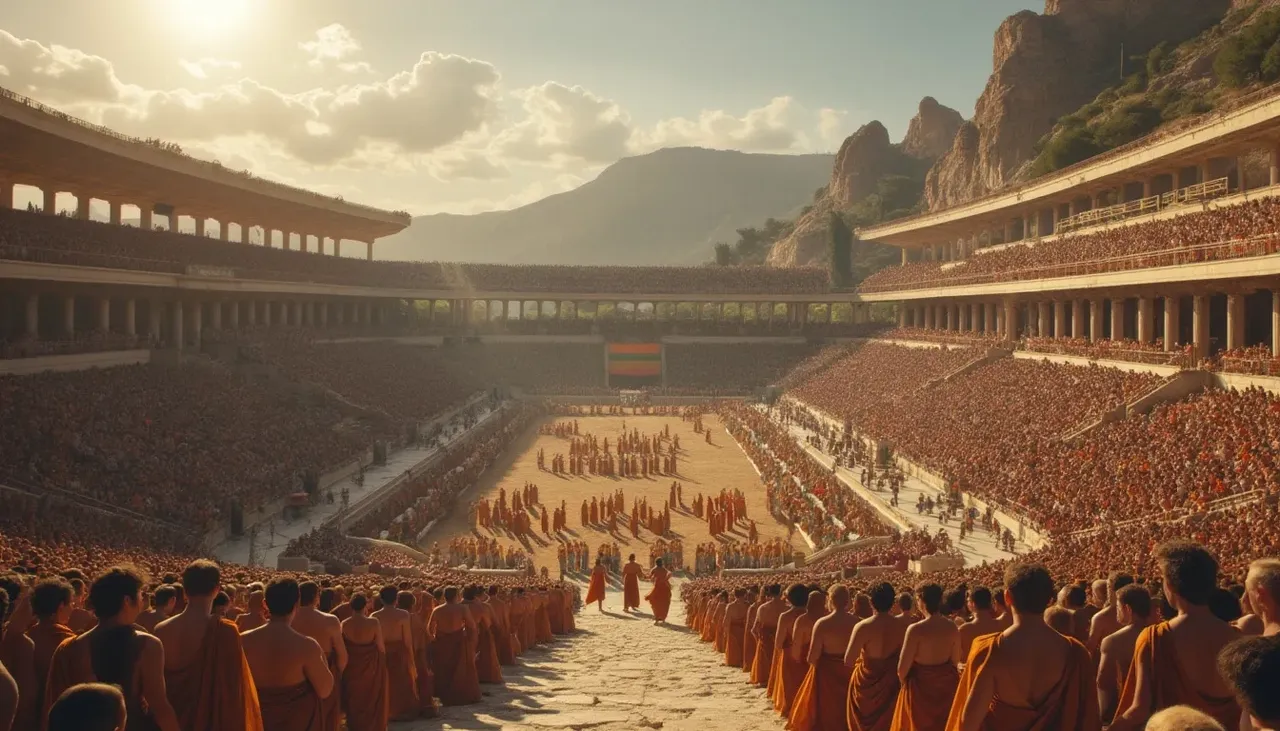
The first recorded Olympic Games in 776 BCE featured only one event: the stadion race, a short footrace that was approximately 192 meters (or one stadion) in length. The race took place in the stadium at Olympia, and the winner, Coroebus of Elis, became the first Olympic victor.
The Stadion Race: The stadion race was the premier event of the early Olympic Games and was run by athletes who competed in the nude, a common practice in Greek athletics that symbolized purity and dedication to the gods.
3.3. The Athletes and Participants
Only freeborn Greek men were allowed to compete in the Olympic Games, and athletes came from various city-states across Greece. Women were not permitted to participate in or even attend the games, although they could compete in separate religious festivals held in honor of Hera, such as the Heraean Games.
Eligibility and Social Status: The Olympic Games were open to men of all social classes, although wealthier individuals often had an advantage due to their ability to afford trainers and better preparation. The games provided an opportunity for both the elite and common citizens to achieve glory.
4. Religious and Cultural Significance of the Games
4.1. Honoring Zeus and the Gods
The Olympic Games were deeply connected to Greek religious practices. The event was held in honor of Zeus, and sacrifices were made to the gods as part of the festival. Athletes competed not only for personal glory but also to honor the gods, particularly Zeus, who was seen as the protector of athletes.
The Sacred Truce (Ekecheiria): During the Olympic Games, a sacred truce, known as the ekecheiria, was declared, which ensured that athletes and spectators could travel safely to Olympia without fear of conflict or war. This truce emphasized the religious and unifying nature of the games.
4.2. The Role of Competition in Greek Society
Competition, or agon, was a central aspect of Greek culture, and the Olympic Games were the ultimate expression of this competitive spirit. The Greeks believed that striving for excellence in athletics, warfare, and intellectual pursuits was a way to achieve honor and glory.
Athletic Excellence as a Path to Immortality: Victorious athletes were celebrated throughout Greece and often immortalized in statues, poems, and other forms of art. The winners of the Olympic Games were seen as achieving a form of immortality through their deeds, earning the admiration of their city-states and the gods.
5. Expansion of the Olympic Games
5.1. The Addition of New Events
In the years following the first Olympic Games, additional events were introduced, expanding the scope of the competition. By the 7th century BCE, the Olympic Games included a variety of athletic contests, including wrestling (pale), boxing (pyx), and the pentathlon, which consisted of five events: the long jump, discus throw, javelin throw, footrace, and wrestling.
The Pentathlon: The pentathlon was one of the most prestigious events in the ancient Olympics, as it required athletes to excel in multiple disciplines, showcasing their versatility and overall athletic ability.
5.2. Equestrian Events
Chariot racing and horseback riding were also introduced to the Olympic Games, with the first recorded chariot race taking place in 680 BCE. These events were often dominated by wealthy participants, as only the rich could afford to maintain horses and chariots.
The Prestige of Chariot Racing: Chariot racing became one of the most popular events at the Olympics, with winners often receiving immense honor and praise. Unlike the footraces, which were won by individual athletes, chariot races were often won by the owners of the horses and chariots, who were typically aristocrats.
5.3. Pankration: The Ultimate Test of Strength
One of the most brutal events introduced to the Olympic Games was the pankration, a combination of boxing and wrestling that allowed few rules and often resulted in serious injury or death. The pankration was seen as the ultimate test of an athlete’s strength, endurance, and fighting skill.
The Violence of Pankration: Pankration matches had minimal rules, with no biting or gouging allowed, but nearly anything else was permitted. The event was notorious for its violence, and it became one of the most popular spectacles in the ancient games.
6. Olympic Victors and Their Rewards
6.1. The Prize of the Olive Wreath
Winners of the Olympic Games received a simple yet highly symbolic prize: a wreath made of olive leaves, known as a kotinos, which was cut from the sacred olive tree near the temple of Zeus at Olympia. Although the olive wreath had no monetary value, it represented the highest honor in Greek society.
The Symbolism of the Olive Wreath: The olive tree was sacred to Zeus and was a symbol of peace and prosperity. The wreath bestowed on Olympic victors signified their favor with the gods and their contribution to the glory of their city-state.
6.2. Fame and Honors for Olympic Victors
Olympic victors were celebrated as heroes upon their return to their city-states. They were often given free meals for life, exemption from taxes, and other privileges. Poets and artists immortalized their victories in works of art, and statues of the athletes were erected in Olympia and their hometowns.
Civic Pride and Olympic Glory: The victory of an athlete brought immense pride to their city-state, and the Olympic Games became a way for city-states to compete with one another on the international stage. Victorious athletes were seen as embodying the strength and virtues of their home city.
7. The Role of Women in the Olympic Games
7.1. Exclusion of Women from the Games
Women were not allowed to compete in or even attend the ancient Olympic Games. Married women, in particular, were prohibited from entering the Olympic stadium, and those caught violating this rule could be punished by death. However, unmarried women were allowed to watch the events.
The Heraean Games: While women were excluded from the Olympic Games, they had their own separate athletic competition known as the Heraean Games, which were held in honor of the goddess Hera. These games featured footraces for young women and provided an opportunity for women to demonstrate their athletic ability.
7.2. Kyniska: A Female Olympic Victor
Despite the restrictions on female participation, there is one notable exception: Kyniska, a Spartan princess, became the first woman to win an Olympic victory in the chariot race in the early 4th century BCE. Although she did not personally compete, as women were not allowed to race, she owned the horses and chariot that won the event, making her the official victor.
The Legacy of Kyniska: Kyniska’s victory challenged the traditional gender roles of ancient Greece and demonstrated that women could achieve Olympic glory, even if indirectly. Her success paved the way for other wealthy women to participate in equestrian events as owners of chariots and horses.
8. The Decline and Revival of the Olympic Games
8.1. The Decline of the Ancient Olympics
The ancient Olympic Games continued for over 1,000 years, with the final recorded games taking place in 393 CE. By this time, the Roman Empire had absorbed Greece, and the games had lost much of their religious and cultural significance. The rise of Christianity, which viewed the pagan rituals associated with the games as heretical, also contributed to their decline.
The Role of Christianity in Ending the Games: In 393 CE, the Roman Emperor Theodosius I, a devout Christian, officially banned all pagan festivals, including the Olympic Games. This marked the end of the ancient games, which had been held for over a millennium.
8.2. The Revival of the Olympic Games in the Modern Era
The Olympic Games were revived in the late 19th century, thanks to the efforts of French educator Pierre de Coubertin, who sought to promote international peace and unity through sport. The first modern Olympic Games were held in Athens in 1896, nearly 1,500 years after the last ancient games.
The Legacy of the Ancient Olympics: The modern Olympic Games were inspired by the values and traditions of the ancient games, including the emphasis on athletic excellence, fair competition, and international cooperation. Today, the Olympics remain one of the most important global events, bringing together athletes from around the world to compete in the spirit of friendship and unity.
9. Conclusion: The Enduring Legacy of the Ancient Olympic Games
The first Olympic Games in 776 BCE marked the beginning of a tradition that would shape the culture and identity of ancient Greece for centuries. More than just an athletic competition, the games were a religious, cultural, and political event that brought together city-states, honored the gods, and celebrated the human spirit.
A Tradition of Excellence: The ancient Olympic Games set the standard for athletic excellence and competition, values that continue to be celebrated in the modern Olympic Games. The legacy of the ancient games endures in the Olympic motto, “Citius, Altius, Fortius” (Faster, Higher, Stronger), which embodies the timeless pursuit of greatness.
A Celebration of Unity and Diversity: While the ancient Olympic Games were limited to Greek participants, the modern Olympics have expanded to include athletes from every corner of the globe, promoting unity, peace, and understanding through sport. The spirit of the ancient games lives on in the modern world, serving as a reminder of the power of athletic achievement and human connection.
The story of the first Olympic Games is not only a tale of competition but also a reflection of the values that defined ancient Greek society—values that continue to inspire athletes and spectators around the world today.
Leave a Reply