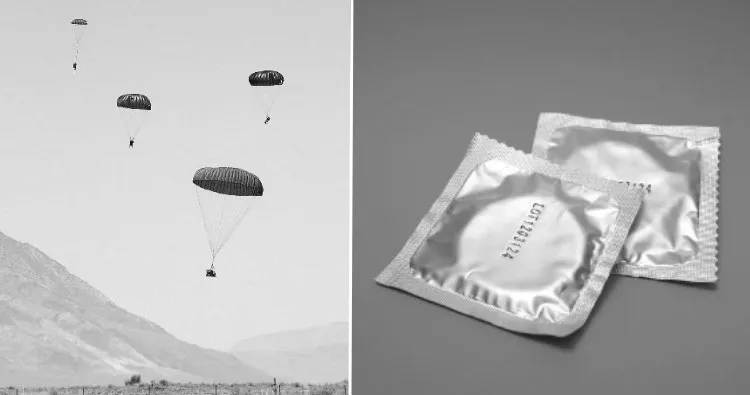
The CIA’s Bizarre Cold War Plan: XL Condoms Labeled “Medium” to Intimidate the Soviets
During the height of the Cold War, both the United States and the Soviet Union engaged in numerous psychological operations (PSYOPs) designed to confuse, demoralize, or intimidate the other side. These operations ranged from elaborate misinformation campaigns to bizarre and outlandish proposals. One of the strangest ideas ever considered by the CIA was a plan to drop extra-large condoms labeled as “medium” onto Soviet territory, with the intention of making Soviet citizens believe that American men were anatomically superior, and by extension, that the U.S. was more powerful as a nation.
Though it never came to fruition, the plan stands as a curious example of the lengths to which the CIA and U.S. military strategists were willing to go to assert dominance during the Cold War, often through psychological warfare rather than direct confrontation. This proposal sought to exploit sexual insecurities and the perceived link between physical attributes and military strength, turning an anatomical comparison into a potential symbol of American superiority.
The Origins of the Plan
The Cold War was an era marked by intense rivalry between the United States and the Soviet Union, with both superpowers vying for global influence. Alongside the arms race and the space race, there was a quieter but equally potent battle for psychological supremacy. Psychological warfare was seen as an effective means to undermine the morale of the enemy, and both the CIA and the KGB engaged in numerous PSYOPs during the conflict.
The idea to drop condoms labeled “medium” as a tactic in this psychological battle emerged from the broader context of Cold War strategizing, where anything that could weaken the confidence of the Soviet population or its leadership was considered a potential asset. The CIA’s thinking was simple: if the Soviets believed that American men were physically larger or stronger, they might internalize this as a sign that the U.S. was also superior in other areas—most importantly, in terms of military strength and technological advancement.
Sexuality and masculinity have long been tied to perceptions of power, and the plan to drop XL condoms with misleading labels aimed to exploit this psychological association. By distributing condoms that were significantly larger than standard sizes and labeling them “medium,” the CIA hoped to send a message that American men were not only bigger but that their “average” was far beyond what the Soviets could measure up to.
The Psychological Aspect: Undermining Soviet Morale
At the core of the plan was the belief that people are easily swayed by subtle, psychological messages that challenge their own sense of identity or self-worth. The CIA hoped that the Soviet military and public would perceive the larger-than-normal condoms as proof that American men were physically superior, leading to a subtle but potentially demoralizing sense of inferiority.
In a society like the Soviet Union, where the state promoted images of strength, unity, and power, planting seeds of doubt about even seemingly trivial matters—such as physical attributes—could be an effective psychological weapon. If the condoms made Soviet soldiers, men, and officials feel less physically imposing in comparison to their American counterparts, it could erode their confidence in their own superiority, and by extension, the strength of the Soviet state.
The tactic relied on symbolic communication, using sexual innuendo to assert American dominance without firing a single shot. While it may seem humorous, the underlying goal was serious: to undermine the morale of Soviet citizens and soldiers, potentially leading to a weakening of the Soviet resolve in the broader geopolitical struggle.
Why the Plan Was Never Executed
Despite the creativity of the idea, the plan to drop condoms labeled “medium” was never put into action. There are several reasons why it likely remained just a proposal on the drawing board:
Risk of Backfiring: The psychological tactic, while potentially clever, could have backfired if the Soviets saw through the ploy and exposed the plan as propaganda. This could have embarrassed the U.S. and reduced the credibility of its PSYOPs.
Logistical Challenges: Dropping condoms over Soviet territory would have required significant resources and risked detection. It also wasn’t clear how widespread the distribution would need to be to achieve the desired effect.
Ethical and Diplomatic Concerns: While the Cold War was characterized by numerous covert operations and intelligence tactics, the idea of dropping condoms to demoralize an enemy population might have been seen as too crude or undignified for the CIA or U.S. military leadership. There was also the concern that such a tactic could strain diplomatic relations further.
Lack of Proven Effectiveness: Though it might have worked on a symbolic level, there was no guarantee that the plan would have had any measurable impact on Soviet morale. It was ultimately considered too far-fetched or impractical compared to other psychological warfare tactics that were already in use.
Cold War Psychological Warfare: A Broader Context
The Cold War was full of strange and creative ideas designed to manipulate public perception. Some notable examples include:
Operation Mongoose: A series of covert CIA operations aimed at destabilizing the regime of Cuban leader Fidel Castro. These included everything from attempts to assassinate Castro to absurd plots to discredit him by making his beard fall out.
Operation Northwoods: A proposed (but ultimately rejected) plan to stage fake terrorist attacks on U.S. soil to justify military intervention in Cuba.
Radio Free Europe: A long-running program that broadcast anti-Soviet propaganda and news to Eastern Bloc countries, attempting to weaken Soviet control over their satellite states.
In the grand scheme of Cold War psychological operations, the condom plan stands out as one of the most unusual, demonstrating the lengths to which intelligence agencies were willing to go to gain an edge over their adversaries. While many other PSYOPs involved more direct political or military themes, the condom plan took a different approach, attempting to undermine Soviet pride in a very personal and intimate way.
Conclusion: A Cold War Oddity
The CIA’s plan to drop XL condoms labeled “medium” on Soviet territory is one of the strangest—and least known—episodes of the Cold War. While it was never executed, the mere fact that it was considered highlights the creativity (and sometimes absurdity) that defined psychological warfare during this period. The plan was emblematic of the larger effort to weaken the Soviet Union not just militarily but psychologically, using every tool at the U.S.’s disposal, no matter how unconventional.
Though it remains a footnote in the long history of Cold War espionage and propaganda, the condom plan is a reminder of how psychological tactics were employed to influence perception and morale on both sides of the Iron Curtain.
Leave a Reply