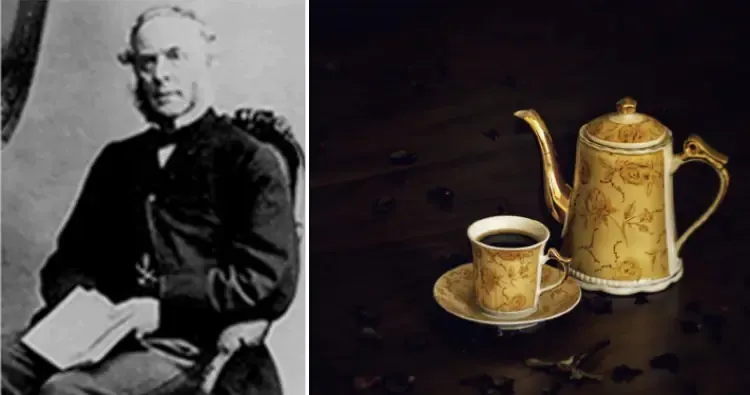
The British Tea Heist: Robert Fortune’s Mission to Steal China’s Tea Secrets
In the mid-19th century, Britain was facing a significant problem: its rapidly growing demand for tea was dependent on China, which held a near-monopoly on the tea trade. To break China’s stranglehold on tea production, the British hatched a daring plan to steal the secrets of Chinese tea cultivation and bring them to India, then under British control. The man tasked with this covert operation was a Scottish botanist named Robert Fortune, who would embark on one of the most audacious episodes of industrial espionage in history.
Fortune’s mission to infiltrate the Chinese tea industry and smuggle out not only tea plants but also the intricate knowledge of tea cultivation and processing helped lay the foundation for Britain’s tea empire in India, particularly in the regions of Darjeeling and Assam. This remarkable story of espionage, subterfuge, and the eventual rise of Indian tea production would have a lasting impact on the global tea industry.
The Context: Britain’s Dependence on Chinese Tea
By the early 19th century, tea had become an integral part of British culture, with consumption levels soaring across all social classes. However, Britain was almost entirely reliant on China for its supply of tea. The East India Company, which controlled Britain’s trade with China, was forced to pay for the valuable commodity using silver, as China was not interested in British goods in exchange for tea.
This imbalance in trade led to Britain’s growing frustration with the Chinese monopoly on tea production, which was closely guarded by the Qing Dynasty. At the same time, the East India Company was looking for ways to increase the profitability of its vast territories in India. If Britain could establish its own tea plantations in India, it would not only reduce its dependence on China but also enable the East India Company to profit immensely from the booming tea market.
Robert Fortune: The Botanic Spy
In 1848, the East India Company enlisted the help of Robert Fortune, a Scottish botanist who had already spent years in China collecting plant specimens. Fortune had a deep understanding of botany and had previously published works on Chinese flora. His knowledge of the region, combined with his experience in botany, made him the perfect candidate for the covert mission to steal the secrets of tea cultivation.
Fortune’s mission was not just to acquire tea plants but also to learn the detailed methods of cultivating, processing, and manufacturing tea, which were closely guarded secrets in China. This required Fortune to blend in with the local population, often disguising himself as a Chinese merchant and traveling deep into tea-growing regions where foreigners were not usually allowed.
The Espionage Operation: Stealing China’s Tea Secrets
To complete his mission, Fortune employed various tactics, including disguises and hiring local guides who could help him navigate China’s tea-growing provinces. He traveled through regions like Fujian and Anhui, where the finest Chinese teas, such as green tea and black tea (then known as Bohea tea), were grown. During these expeditions, he observed the techniques used by Chinese tea farmers and tea masters, learning the subtleties of growing, harvesting, and processing tea.
One of the most crucial aspects of Fortune’s mission was to understand the difference between green tea and black tea processing, which was largely a mystery to Westerners at the time. Contrary to common belief in the West, both green and black tea came from the same plant, Camellia sinensis—the difference lay in how the leaves were processed. Green tea was lightly processed and not fermented, while black tea underwent a fermentation process that gave it a stronger flavor.
In addition to gathering knowledge, Fortune also smuggled tea plants and seeds out of China. Using specially designed glass containers called Wardian cases—which acted as mini-greenhouses to keep the plants alive during long sea voyages—he managed to transport these valuable specimens safely to India.
Challenges and Successes
Fortune’s mission was fraught with challenges. He had to navigate through remote regions where foreigners were often met with suspicion, and he was constantly at risk of being discovered. Moreover, the Chinese were highly protective of their tea-making knowledge, and Fortune had to gain the trust of locals to learn the finer details of tea production.
Despite these challenges, Fortune was successful in acquiring thousands of tea plants and seeds, as well as detailed knowledge of the cultivation and processing methods used in China. He shipped the plants to Darjeeling and Assam, regions identified by the British as having the right climate and altitude for growing tea.
The Impact: The Rise of Indian Tea
The success of Robert Fortune’s mission had profound and lasting effects. The tea plants and knowledge he brought from China were used to establish tea plantations in British-controlled India. By the mid-19th century, India was producing its own tea on a large scale, and the British Empire was no longer solely dependent on Chinese tea. Indian tea, particularly from Assam and Darjeeling, would soon rival Chinese tea in both quality and quantity, transforming the global tea market.
The expansion of tea production in India allowed the British to significantly reduce their imports from China. Additionally, Indian tea became a key export for the British Empire, creating vast wealth for the East India Company and its successors.
The British government’s dominance of the tea trade in India helped solidify tea’s place as a cornerstone of British culture. By the late 19th century, Indian tea had largely replaced Chinese tea on British tables, and the afternoon tea tradition became firmly established as a symbol of British identity.
Legacy of Robert Fortune’s Espionage
Robert Fortune’s covert operation to steal China’s tea secrets remains one of the most remarkable episodes of industrial espionage in history. His mission laid the foundation for India’s tea industry, which continues to be one of the largest tea producers in the world today. The introduction of Chinese tea cultivation techniques to India fundamentally altered the global tea trade and marked the beginning of India’s rise as a major tea-exporting nation.
While Fortune’s actions were controversial—especially from a modern perspective, where intellectual property theft is viewed as unethical—his legacy is one of innovation and determination. He bridged the gap between two of the world’s greatest tea-producing regions, and in doing so, he helped reshape the global tea industry.
Conclusion: A Tale of Botanical Espionage
Robert Fortune’s mission to steal the secrets of China’s tea industry is a fascinating chapter in the history of global trade and espionage. His successful acquisition of tea plants and knowledge not only allowed Britain to break China’s monopoly on tea but also led to the development of India’s vast tea industry, which still thrives today.
The story of Fortune’s tea heist is a reminder of the lengths to which nations and corporations will go to secure valuable trade commodities, and it underscores the significant role that tea has played in shaping the economies and cultures of both the East and the West.
Leave a Reply