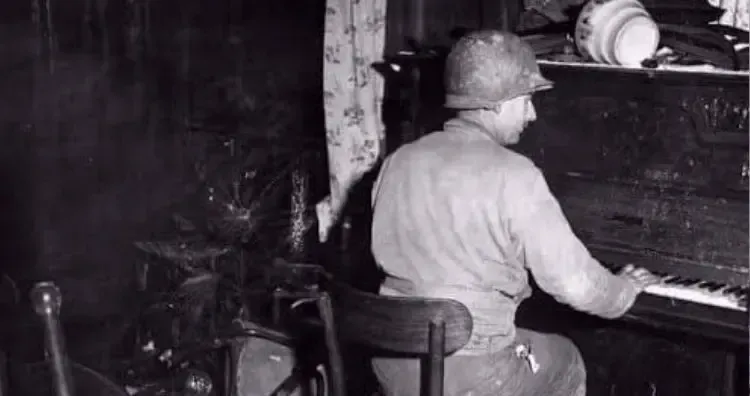
Amidst the Fall of Berlin: The Tragic Tale of a Young SS Soldier Forced to Play the Piano for His Life
The final days of World War II saw the collapse of Nazi Germany and the end of a brutal regime. The Fall of Berlin in April 1945 marked a devastating conclusion to a war that had consumed Europe and the world. It was a time of chaos, destruction, and unimaginable violence, as Soviet forces stormed the German capital, bringing the long-awaited victory to the Allies. Among the countless stories of terror, despair, and cruelty that emerged from this period, one tale stands out as a chilling example of both the human spirit’s endurance and the utter ruthlessness of war: the story of a young SS soldier forced by Soviet troops to play the piano for 22 hours straight under the threat of execution.
In this article, we will explore the harrowing details of this event, placing it within the broader historical context of the Fall of Berlin. We will examine the psychological torment endured by the soldier, the mindset of the Soviet troops, and the unimaginable pressures of combat that created an atmosphere where cruelty and humanity coexisted in the most bizarre ways.
Chapter 1: The Fall of Berlin (Page 1-2)
The Fall of Berlin was the climactic moment of the European theater of World War II. By April 1945, Adolf Hitler’s Third Reich was crumbling under the combined pressure of Allied forces from the West and the relentless advance of the Soviet Union from the East. Soviet forces, under the command of Marshal Georgy Zhukov and Marshal Ivan Konev, launched their final assault on Berlin in mid-April, encircling the city and beginning a brutal siege.
Berlin, the heart of Nazi Germany, was under intense bombardment, and its defenders – composed of Wehrmacht soldiers, SS units, and even the Hitler Youth – were vastly outnumbered and undersupplied. Civilians cowered in bomb shelters as the Red Army swept through the streets, exacting vengeance for the atrocities committed by the Nazis throughout the war.
In this nightmarish scenario, the moral lines between combatants were often blurred. Soviet soldiers, many of whom had witnessed the horrors of the Nazi invasion of their homeland, sought retribution in the streets of Berlin. Acts of violence, rape, and revenge killings were common as the Soviet forces took control of the city.
It was in this chaotic and violent context that the tragic story of a young SS soldier would unfold.
Chapter 2: The SS Soldier (Page 3-4)
The identity of the SS soldier remains shrouded in mystery, but his story is emblematic of the desperation felt by the remnants of the Nazi regime in the final days of the war. As part of the elite military wing of the Nazi Party, the SS had been responsible for some of the most heinous war crimes of the conflict, including the enforcement of Hitler’s racial policies and the management of concentration camps.
By April 1945, even the SS could not escape the inevitability of defeat. The young soldier, likely no older than 18 or 19, was one of thousands conscripted into the final defense of Berlin. His ideological indoctrination and training would have made him a firm believer in Hitler’s vision for Germany, though by this point, it is likely that he, like many others, understood the futility of their efforts.
Captured by Soviet forces during the final assault on Berlin, this SS soldier’s fate was sealed. However, instead of executing him immediately, his captors devised a more insidious form of psychological torment.
Chapter 3: The Piano and the Warning (Page 5-6)
During the aftermath of his capture, the SS soldier found himself surrounded by Soviet soldiers who had taken over a building that housed a piano. Soviet troops often came across looted or abandoned homes in Berlin, and this piano was likely left behind by a fleeing German family. It was here that the Soviet troops, under the haze of war and likely under the influence of alcohol and adrenaline, forced the SS soldier to sit down at the piano.
Using sign language and gestures, the Soviets communicated to the young soldier that he would have to play continuously. If he stopped, even for a moment, they warned him that they would execute him on the spot. Whether they wanted to humiliate him or simply toy with their captive remains unclear, but the threat was real. The piano became his lifeline, his only hope of surviving an unimaginable ordeal.
Chapter 4: 22 Hours of Music (Page 7-8)
For the next 22 hours, the SS soldier played the piano without rest. His fingers, initially trained and disciplined, would have eventually cramped and ached under the strain. The psychological pressure of knowing that one mistake could result in death was overwhelming. Every note he played was a plea for mercy, but it was also a manifestation of his will to survive.
Music, under normal circumstances, is a form of expression, but for this young soldier, it became a desperate performance of endurance. His captors likely taunted him throughout the ordeal, mocking his efforts and reminding him of the consequences of failure. Exhaustion, both mental and physical, must have set in within the first few hours, yet he continued, driven by the primal instinct to survive.
The room must have been filled with a surreal and haunting atmosphere. The sound of the piano, an instrument of beauty, filled the air in a city being torn apart by violence and destruction. As the SS soldier played, Berlin crumbled around him, its people dying in the streets, its buildings reduced to rubble.
Chapter 5: The Collapse (Page 9-10)
After 22 grueling hours, the SS soldier could no longer continue. His body, exhausted and trembling, finally gave in. With tears streaming down his face, he collapsed at the piano, unable to play another note. He had endured as long as humanly possible, and in that moment, he may have hoped that his tormentors would show him mercy.
But mercy was not to be found in the battle-hardened Soviet troops who had forced him to perform this cruel task. Instead, they congratulated him for his efforts, mocking him once more. Then, in a cold and calculated act of cruelty, they shot him dead.
The soldier’s body slumped over the piano, and the last notes he had played lingered in the air, marking the end of a life cut short by both the brutal regime he served and the brutal revenge of those who had defeated it.
Chapter 6: The Soviet Perspective (Page 11-12)
The behavior of the Soviet troops in this story is a reflection of the intense psychological and emotional toll that the war had taken on them. The Red Army had borne the brunt of the fighting on the Eastern Front, suffering horrific losses in battles such as Stalingrad and Kursk. The German invasion of the Soviet Union, known as Operation Barbarossa, had resulted in mass death and destruction, leaving millions of Soviet civilians and soldiers dead.
By the time the Red Army reached Berlin, many Soviet soldiers were fueled by a desire for vengeance. The atrocities they had witnessed and endured during the war made them ruthless and often indiscriminately cruel in their treatment of German civilians and soldiers alike.
The SS, in particular, was viewed with special hatred by the Soviets, as this paramilitary organization had been responsible for many of the worst atrocities of the Nazi regime. For Soviet soldiers, the sight of an SS uniform was a reminder of the horrors inflicted on their homeland. The piano ordeal inflicted on the young SS soldier can be seen as an expression of that rage and desire for retribution, mixed with a perverse need to assert dominance over a defeated enemy.
Chapter 7: The Human Cost of War (Page 13-14)
The tragic tale of the SS soldier forced to play the piano for his life is just one of countless stories that illustrate the human cost of war. The soldier, no doubt indoctrinated by Nazi propaganda, was a product of the regime he served. Yet, in the end, he was just another young man caught in the machinery of a global conflict that had spiraled out of control.
War dehumanizes everyone it touches. The Soviet soldiers who forced the young man to play the piano had been dehumanized by the relentless violence and trauma they had experienced. In turn, they dehumanized their captive, reducing him to an object of amusement and cruelty.
The collapse of Berlin marked the end of one of the most destructive wars in human history, but the scars left by that war would remain for decades. The piano, a symbol of culture and humanity, became in this story a twisted tool of torture and death. It serves as a reminder that even in moments of apparent triumph, war has the power to strip away the very things that make us human.
Chapter 8: Remembering the Tragedy (Page 15)
In the years following the war, the story of the SS soldier who played the piano under threat of execution became a dark and poignant anecdote, passed down as a reflection of the horrors that Berlin witnessed in its final days. While the story has never been fully verified in historical documents, it remains a powerful symbol of the cruelty and absurdity of war.
In remembering this tale, we are reminded not only of the specific tragedy that befell this soldier but also of the countless other lives that were cut short, brutalized, and forever changed by the war. Whether soldiers or civilians, friend or foe, each individual caught in the maelstrom of World War II experienced suffering in ways that are difficult to comprehend fully.
The story of the SS soldier and his forced piano performance stands as a testament to the lengths to which humans will go to survive and the cruelty that others are capable of inflicting. In the end, it is a tragic reminder of the price of war and the fragile line between life and death in times of unimaginable chaos.
Conclusion: A Legacy of Suffering
The Fall of Berlin was a cataclysmic event that brought World War II to a close, but it also revealed the depths of human suffering and cruelty. The story of the young SS soldier forced to play the piano under threat of execution captures the essence of that moment: a mixture of endurance, desperation, and tragic futility.
As we reflect on the events of that time, we are reminded that history is full of stories like this—stories that show both the best and the worst of humanity. In the end, the SS soldier’s fate serves as a cautionary tale about the dangers of war and the psychological toll it takes on everyone involved.
May we remember this story not just as a historical curiosity but as a sobering reminder of the human cost of conflict, and may it inspire us to strive for a future where such tragedies no longer occur.
Leave a Reply