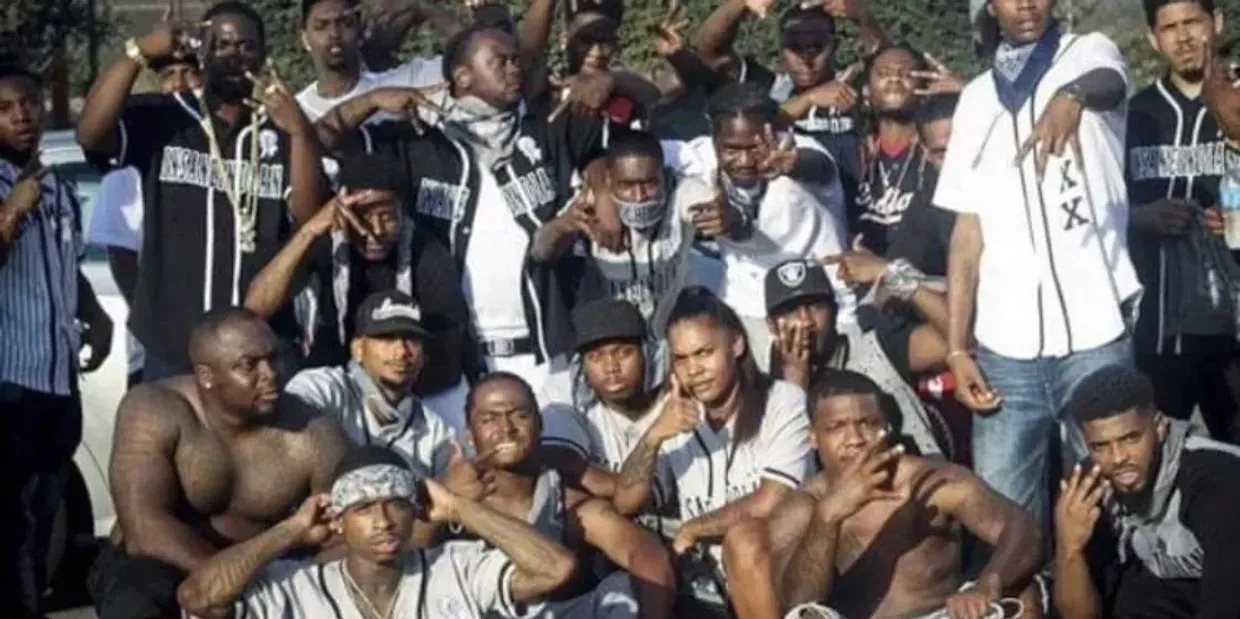
The Crips are a primarily African-American alliance of street gangs
The Crips are a primarily African-American alliance of street gangs that are based in the coastal regions of Southern California. Founded in Los Angeles, California, in 1969, mainly by Raymond Washington and Stanley Williams, the Crips began as an alliance between two autonomous gangs, and developed into a loosely connected network of individual “sets”, often engaged in open warfare with one another. Its members have traditionally worn blue clothing since around 1973.
The Crips are one of the largest and most violent associations of street gangs in the United States. With an estimated 30,000 to 35,000 members in 2008,[4] the gangs’ members have been involved in murders, robberies and drug dealing, among other crimes. They have a long and bitter rivalry with the Bloods.
Some self-identified Crips have been convicted of federal racketeering.
Etymology
Main article: Debate over the origins of the Crips gang
Some sources suggest that the original name for the alliance, “Cribs”, was narrowed down from a list of many options and chosen unanimously from three final choices, over the Black Overlords and the Assassins. Cribs was chosen to reflect the young age of the majority of the gang members. The name evolved into “Crips” when gang members began carrying around canes to display their “pimp” status. People in the neighborhood then began calling them cripples, or “Crips” for short. In February 1972 the Los Angeles Times used the term.
Another source suggests “Crips” may have evolved from “Cripplers”, a 1970s street gang in Watts, of which Washington was a member. The name had no political, organizational, cryptic, or acronymic meaning, though some have suggested it stands for “Common Revolution In Progress”, a backronym. According to the film Bastards of the Party, directed by a member of the Bloods, the name represented “Community Revolutionary Interparty Service” or “Community Reform Interparty Service”.
History
Main article: Debate over the origins of the Crips gang
Gang activity in South Central Los Angeles has its roots in a variety of factors dating to the 1950s, including: post-World War II economic decline leading to joblessness and poverty; racial segregation of young African American men, who were excluded from organizations such as the Boy Scouts, leading to the formation of black “street clubs”; and the waning of black nationalist organizations such as the Black Panther Party and the Black Power Movement.
Stanley “Tookie” Williams met Raymond Lee Washington in 1969, and the two decided to unite their local gang members from the west and east sides of South Central Los Angeles in order to battle neighboring street gangs. Most of the members were 17 years old. Williams however appears to discount the sometimes-cited founding date of 1969 in his memoir, Blue Rage, Black Redemption.
In his memoir, Williams also refuted claims that the group was a spin-off of the Black Panther Party or formed for a community agenda, writing that it “depicted a fighting alliance against street gangs—nothing more, nothing less.” Washington, who attended Fremont High School, was the leader of the East Side Crips, and Williams, who attended Washington High School, led the West Side Crips.
Williams recalled that a blue bandana was first worn by Crips founding member Curtis “Buddha” Morrow, as a part of his color-coordinated clothing of blue Levis, a blue shirt, and dark blue suspenders. A blue bandana was worn in tribute to Morrow after he was shot and killed on February 23, 1973. The color then became associated with Crips.
By 1978, there were 45 Crip gangs, called sets, in Los Angeles. They were heavily involved in the production of PCP, marijuana and amphetamines. On March 11, 1979, Williams, a member of the Westside Crips, was arrested for four murders and on August 9, 1979, Washington was gunned down. Washington had been against Crip infighting and after his death several Crip sets started fighting against each other. The Crips’ leadership was dismantled, prompting a deadly gang war between the Rollin’ 60 Neighborhood Crips and Eight Tray Gangster Crips that led nearby Crip sets to choose sides and align themselves with either the Neighborhood Crips or the Gangster Crips, waging large-scale war in South Central and other cities. The East Coast Crips (from East Los Angeles) and the Hoover Crips directly severed their alliance after Washington’s death. By 1980, the Crips were in turmoil, warring with the Bloods and against each other.
Leave a Reply