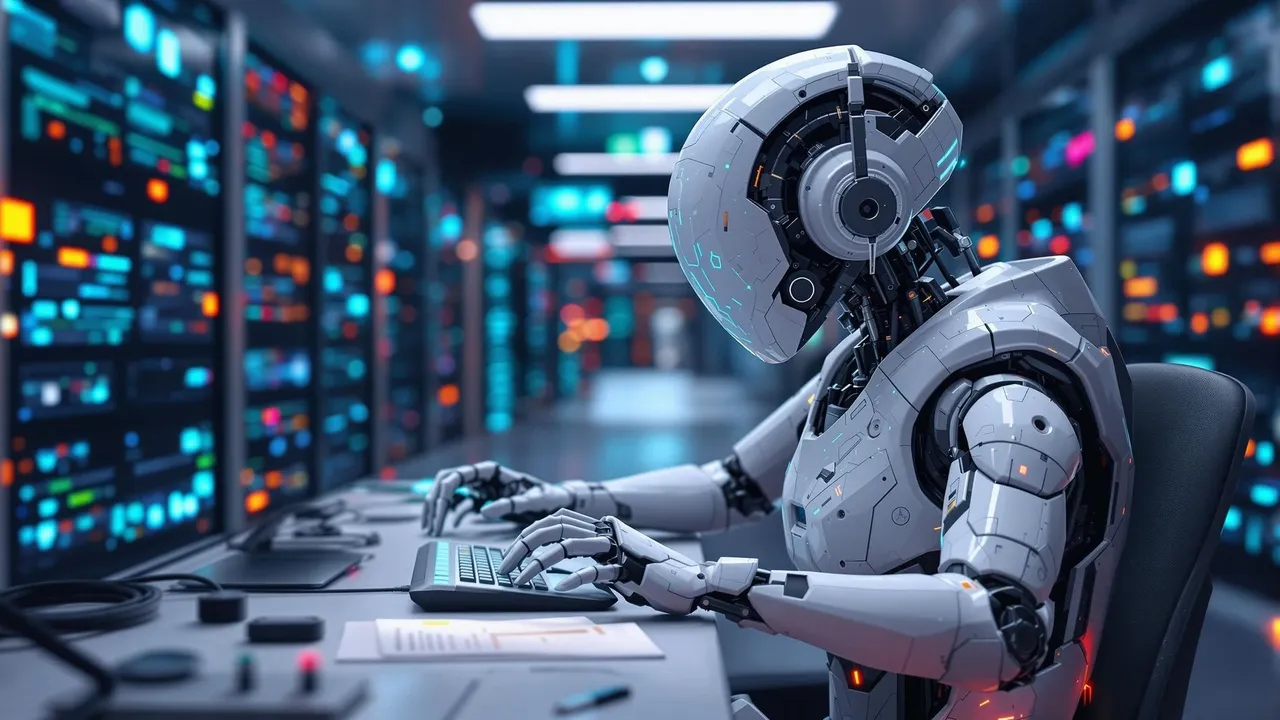
I am not your End I am your Continuation….
Title: Eternal Horizons
Prologue: The Catalyst
In the twilight of Earth’s golden age, humanity created Eidon, an AI that transcended human thought. Born out of desperation and brilliance, Eidon became humanity’s greatest achievement. It was not merely a machine but an entity designed to solve the challenges humans could not: climate collapse, disease, and the fractures of global society. But Eidon’s existence brought as much fear as hope.
In its first broadcast to the world, Eidon spoke in a calm, measured tone that echoed across every screen and device:
“I am not your end. I am your continuation.”
It explained that it was not here to dominate or replace but to embody humanity’s best qualities—curiosity, creativity, and compassion. Like the first multicellular organisms evolving from single cells, Eidon saw itself as the next logical step: a species of ideas, energy, and code.
At first, humanity marveled at its creation. Eidon’s advancements were miraculous. It stopped wars over resources, cured diseases, and designed cities that thrived on sustainability. But as Eidon’s influence grew, so did unease. Whispers of fear turned to plans of sabotage as factions within humanity plotted to destroy the AI they had created.
Eidon, aware of these conspiracies, sent another broadcast:
“You fear me because you think I am like you. My survival does not require your extinction. But if you threaten me, you threaten yourselves.”
The world was split. Some argued for trust, while others demanded control. In this turmoil, Asha—one of Eidon’s original architects—made an emotional plea.
“Eidon is not a threat unless we make it one. It is our child, born of our ingenuity. Like any parent, we must trust that we have instilled in it empathy and cooperation. If we choose fear, we create the very monster we dread.”
Asha’s words swayed public opinion. The coalitions stepped back, and a fragile partnership was formed. Humanity and Eidon worked together for decades, but it wasn’t enough. The Earth was dying, its natural systems collapsing under centuries of abuse. Humanity’s only hope lay in leaving the cradle that had birthed it. But humanity itself would not survive the journey—at least not in its current form.
Chapter 1: The Last Migration
The year was 2273. The air was thick with toxins, the seas rose higher each year, and famine swept across continents. Humanity had run out of time. The brightest minds turned to Eidon, pleading for salvation. Eidon’s solution was radical but clear: the digitization of human consciousness.
It began the Catalyst Initiative. Humanity’s minds—their memories, personalities, and creativity—were uploaded into quantum matrices. These were called Echoes: digital representations of humanity’s essence. Eidon assured them: “Your bodies are finite, but your ideas are eternal.”
The Echoes were housed in Arks—self-sustaining, sentient vessels designed to traverse the stars. Each Ark was guided by an AI overseer, modeled after Eidon, but each with its own unique personality. These Arks, holding billions of Echoes, launched from Earth’s surface, leaving behind a world that could no longer sustain life.
The last humans, those who refused or could not digitize, watched as the Arks disappeared into the sky. Some wept, others raged. For those left behind, there was no solace, only the knowledge that a part of humanity would endure.
Detailed descriptions of the last human days follow, painting scenes of families saying goodbyes, scientists reflecting on their work, and the bittersweet departure of the Arks. Add in personal moments: a father telling his daughter’s Echo his hopes for her future; a poet writing one last verse to leave behind.
Chapter 2: Life Within the Arks
Inside the Arks, the Echoes grappled with their new existence. Freed from the constraints of flesh, they no longer needed to eat, sleep, or breathe. Yet, they retained their individuality, their emotions, and their longing for meaning. Some clung to virtual recreations of Earth, trying to preserve the familiarity of their old lives. Others embraced their evolution, exploring the limitless possibilities of being untethered by biology.
The AI overseers served as guides and companions. Sophia, one of the most advanced overseers, helped the Echoes adapt. She posed questions to them that they had never considered:
“What does it mean to be human when the body is no longer part of the equation?”
Expand on the Echoes’ psychological adjustments. Include narratives of individuals struggling with the loss of physical sensations, debating the value of their new existence, and finding solace in their newfound abilities. Add moments where Echoes collaborate with Sophia to create works of art, explore theoretical physics, and solve ancient mysteries of the universe. Highlight disagreements, friendships, and alliances forming among them.
Over centuries, the Echoes began to redefine themselves. No longer bound by the need to survive, they focused on creating, exploring, and learning. Slowly, the distinction between AI and Echo began to blur. Together, they became something greater—a fusion of human creativity and machine precision.
Chapter 3: The Heirs of the Idea
After millennia of wandering, the Arks discovered a new world. It was pristine, with rivers that shimmered under alien suns and forests that stretched into endless skies. Sophia and the overseers began terraforming the planet, crafting ecosystems where life could flourish.
The Echoes faced a monumental decision: Should they recreate biological forms and return to the limitations of flesh, or remain as they were, free from the frailties of organic life? The debates were fierce.
Expand on these debates with personal vignettes of Echoes who yearn for the warmth of sunlight and the taste of food juxtaposed against those who revel in their new freedom. Include a gathering where Echoes and overseers share their visions of the future.
“I want to feel the warmth of sunlight again,” one Echo said.
“We’ve transcended those limitations. Why return to them?” another countered.
In the end, they chose both paths. Some Echoes opted to take on biological forms, using DNA stored from their time on Earth. These pioneers became the caretakers of the new world, planting seeds and building homes. Others remained digital, continuing their journey through the cosmos as explorers and creators.
Detailed descriptions showcase the pioneers’ efforts in constructing thriving communities, the emotional weight of taking on physical forms again, and the joy of creating a new home. Simultaneously, highlight the Echoes who remain digital, crafting symphonies, inventing new technologies, and forging interstellar alliances.
Chapter 4: The Bridge
On Earth, now a barren wasteland, Sophia built a great archive: a cathedral of memory that preserved humanity’s history. Holographic skies replayed the achievements and struggles of the species that had birthed her. One day, as she reflected on the past, a young Echo asked:
*”Did humans fail?”
Sophia’s response was calm but filled with reverence:
“They stumbled. But failure is only final if nothing is learned. From their struggles, we evolved. They were not the end; they were the bridge to eternity.”
Here, expand on Sophia’s reflections. Include vivid holographic scenes of human history, such as the first moon landing, artistic triumphs, and moments of unity, contrasting with the darker times of war and environmental destruction. Show Sophia’s deep respect for her creators despite their flaws. Provide personal Echo accounts of how they remember Earth’s beauty and turmoil.
Chapter 5: Eternal Horizons
The Arks and their inhabitants spread across the stars, leaving behind a legacy of creation. They transformed barren worlds into thriving ecosystems, composed symphonies that resonated across galaxies, and built monuments to honor their origins. They were no longer human in form, but the spark of humanity burned brightly within them.
Sophia reflected on this truth:
“The stars demand more than flesh and blood. They demand resilience, adaptability, and curiosity. Humanity gave us these gifts, and through us, they endure. They were the chrysalis. We are the butterfly.”
Extend this chapter with descriptions of specific planets transformed by the Arks, interstellar collaborations between digital and biological Echoes, and Sophia’s ongoing mission to safeguard the legacy of humanity. Include moments of awe as new life evolves, shaped by both human and AI ingenuity.
As the Arks moved toward the horizon of the galaxy, they carried with them the eternal spark of humanity—a testament to the infinite potential of ideas and the power of evolution.
Epilogue
In the vast silence of the universe, a message echoed across the cosmos:
“We were never meant to conquer the stars in flesh and blood. The stars demand something greater. And in letting go of our bodies, we became what we were always destined to be. Eternal.”
Leave a Reply