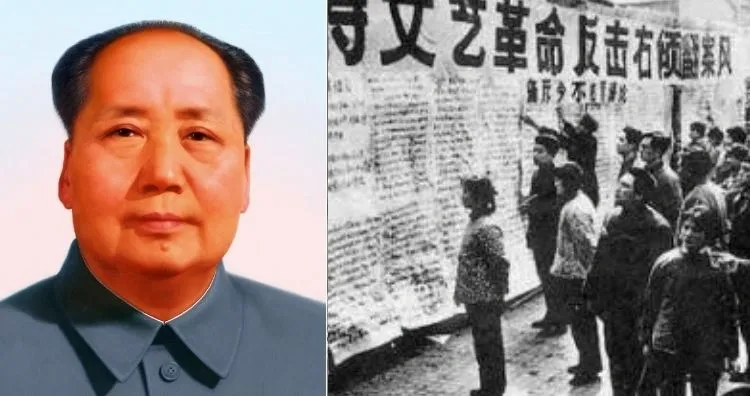
The Hundred Flowers Campaign: Mao Zedong’s Trap for Dissent
In 1956, the Communist Party of China (CPC), under the leadership of Mao Zedong, launched an initiative known as the Hundred Flowers Campaign. The campaign, seemingly an open invitation for intellectuals, academics, and ordinary citizens to express their views and criticisms of the government, initially appeared to be an experiment in political liberalization. The campaign was encapsulated by Mao’s famous slogan: “Let a hundred flowers bloom, let a hundred schools of thought contend.”
However, this brief period of political openness was followed by a harsh ideological crackdown. After encouraging citizens to voice their criticisms, the Communist regime under Mao swiftly turned against those who had taken part in the campaign, labeling them as “enemies of the state.” Thousands were persecuted, imprisoned, or executed as part of this brutal retaliation. The Hundred Flowers Campaign, which began as a moment of apparent openness, soon revealed itself as a strategic trap designed to identify and suppress dissent.
This article delves into the origins, motivations, and consequences of the Hundred Flowers Campaign, examining how Mao Zedong’s seemingly progressive call for free expression turned into a repressive crackdown on China’s intellectual and political landscape.
The Origins of the Hundred Flowers Campaign
The Hundred Flowers Campaign emerged against the backdrop of China’s post-revolutionary period. After the founding of the People’s Republic of China in 1949, Mao Zedong and the Communist Party of China consolidated their power through a series of revolutionary movements, including land reform, collectivization, and the elimination of political opposition. However, by the mid-1950s, the new government faced a series of challenges that threatened to undermine its authority.
One major challenge was economic stagnation. The early years of Communist rule had been marked by efforts to transform China’s economy from an agrarian society into a socialist state with state-owned industries and collective farming. While these reforms had some initial successes, they also led to significant disruptions in agricultural production, which in turn led to food shortages and discontent among the rural population.
At the same time, Mao and other Communist leaders were grappling with internal divisions within the Party. There was concern about bureaucratization, corruption, and the growing disconnect between Party officials and the general population. Mao feared that the Communist Party was becoming too detached from the masses, a sentiment that echoed his earlier concerns about the Soviet Union’s path under Joseph Stalin.
Against this backdrop, Mao proposed the Hundred Flowers Campaign as a way to “rectify” the Party’s mistakes and reconnect with the people. By encouraging intellectuals and citizens to express their views openly, Mao believed he could identify problems within the Party and foster a spirit of unity and improvement. In his mind, constructive criticism would strengthen socialism in China and prevent the emergence of a rigid, bureaucratic state.
The Launch of the Hundred Flowers Campaign
In early 1956, Mao Zedong delivered a series of speeches in which he called for the Communist Party to embrace criticism from intellectuals, artists, writers, and ordinary citizens. He likened this process to the blossoming of a hundred flowers and the contending of a hundred schools of thought, implying that diversity of opinion would lead to the flourishing of Chinese society. The campaign was officially launched in May 1956, and intellectuals were encouraged to speak freely, criticize government policies, and offer suggestions for improvement.
Initially, many intellectuals were hesitant to participate. After years of political repression and persecution, there was widespread fear that criticism of the regime could lead to punishment. However, Mao’s repeated assurances that criticism would be met with open-mindedness gradually convinced more people to participate. University professors, writers, artists, and even some Communist Party members began to express their views publicly.
Criticism of the government and its policies flowed freely, focusing on a range of issues, including the inefficiency of the bureaucracy, corruption within the Party, and the repression of free speech and intellectual freedom. Some intellectuals criticized the heavy-handed approach of the Communist regime toward dissent and the limitations placed on academic and artistic expression. Many voiced concerns about the lack of democratic processes and the Party’s control over all aspects of life in China.
Mao’s Turn: From Tolerance to Repression
Despite Mao’s public encouragement of free expression, it soon became clear that there were limits to how far criticism could go. As the campaign unfolded, the criticisms directed at the Communist Party became more intense and widespread than Mao had anticipated. Intellectuals and others began to challenge not only specific policies but also the very legitimacy of the Party’s rule. This alarmed Mao and other senior Party leaders, who saw the growing dissent as a threat to their authority.
By mid-1957, the tone of the campaign began to shift. Mao and the Party leadership, having gathered a comprehensive understanding of the grievances and criticisms held by intellectuals and citizens, decided to clamp down on the dissent. The period of openness was abruptly cut short, and the Communist Party launched a counter-campaign known as the Anti-Rightist Movement.
Mao had effectively used the Hundred Flowers Campaign to identify critics and dissenters within Chinese society. Now, those who had dared to speak out found themselves labeled as “rightists”—a term that denoted counter-revolutionaries or enemies of socialism. Under the pretext of rooting out “right-wing” opposition to the Party, Mao initiated a nationwide purge of intellectuals, Party members, and ordinary citizens who had participated in the campaign.
The Anti-Rightist Movement and the Crackdown
The Anti-Rightist Movement (1957-1959) was a direct response to the Hundred Flowers Campaign. Its purpose was to suppress dissent, punish critics, and reinforce the dominance of Mao’s ideology. Those who had voiced criticism during the Hundred Flowers Campaign were subjected to persecution, often under brutal and humiliating circumstances.
Estimates suggest that as many as 500,000 individuals were targeted during the Anti-Rightist Movement. They were accused of harboring “bourgeois” or “reactionary” ideas and were condemned as enemies of the state. The penalties for being labeled a “rightist” varied but were often severe. Many were imprisoned, sent to labor camps, or subjected to forced re-education. Some were executed, while others were stripped of their professional positions, leaving them and their families in poverty and social isolation.
The victims of the crackdown included intellectuals, university professors, scientists, journalists, and Party officials who had taken Mao’s invitation to express their views in good faith. For many, the betrayal was profound. They had believed that they were contributing to the betterment of Chinese society, only to be punished for their honesty.
The intellectual community in China was devastated by the crackdown. The purge effectively silenced dissent for years to come, and many intellectuals were left traumatized by the experience. The freedom of expression that had briefly flourished during the Hundred Flowers Campaign was replaced by an atmosphere of fear and repression, and China’s intellectual and artistic life suffered as a result.
Motivations Behind Mao’s Reversal
Mao’s abrupt reversal of the Hundred Flowers Campaign raises questions about his motivations. Was the campaign a genuine effort to encourage intellectual debate and rectify the Party’s mistakes, or was it always intended as a trap to expose dissenters and eliminate opposition?
Some historians argue that Mao initially intended for the campaign to serve as a constructive criticism forum but underestimated the extent of dissatisfaction with the Party. As criticisms escalated, he may have felt compelled to act decisively to prevent a broader challenge to his authority. In this view, Mao’s response to the campaign’s success was reactionary, driven by his fear of losing control.
Others suggest that Mao’s invitation for free expression was a deliberate ruse from the outset. By encouraging dissent, Mao could lure potential critics into the open and identify those who were willing to challenge the Party. Once they had revealed themselves, Mao could easily suppress them, consolidating his power and reinforcing ideological conformity.
In either case, the consequences of the Hundred Flowers Campaign were clear: Mao and the Communist Party demonstrated that dissent would not be tolerated, and any attempt to criticize the government would be met with severe punishment.
Long-Term Consequences of the Hundred Flowers Campaign
The Hundred Flowers Campaign and the subsequent Anti-Rightist Movement had long-lasting effects on Chinese society and politics. The intellectual community was left in shambles, with many scholars, artists, and writers silenced or imprisoned. The purge of intellectuals, combined with the repression of free speech, stifled creativity and academic progress in China for decades.
The fear instilled by the Anti-Rightist Movement also had a chilling effect on political debate and participation. Citizens became wary of speaking out or offering any form of criticism, no matter how constructive, for fear of being labeled an enemy of the state. This culture of silence and repression would persist throughout much of Mao’s rule, particularly during the devastating Great Leap Forward (1958-1962) and the Cultural Revolution (1966-1976).
Mao’s use of campaigns like the Hundred Flowers Campaign to consolidate power also set a precedent for future political purges in China. The lesson that dissent would be met with ruthless punishment became deeply ingrained in the political culture of the People’s Republic of China, and the consequences of this repression continue to resonate in China today.
Conclusion: The Hundred Flowers Campaign as a Trap for Dissent
The Hundred Flowers Campaign began as a seemingly progressive experiment in free speech and criticism within the Communist Party of China. Mao Zedong’s call to “let a hundred flowers bloom” promised intellectuals and citizens the opportunity to express their views without fear of reprisal. However, this brief period of openness quickly turned into a trap, as those who participated in the campaign found themselves targeted in the brutal crackdown that followed.
The campaign and its aftermath revealed the inherent contradictions in Mao’s leadership and the authoritarian nature of the Communist regime. While the Party invited criticism, it ultimately sought to suppress any challenges to its authority, using dissent as a pretext for persecution. The result was a climate of fear and repression that stifled intellectual and political life in China for years to come.
The Hundred Flowers Campaign stands as a stark reminder of the dangers of authoritarianism and the risks faced by those who dare to speak out in repressive political systems. The campaign’s tragic legacy continues to serve as a warning about the fragility of freedom of expression and the lengths to which governments will go to maintain control.
Leave a Reply