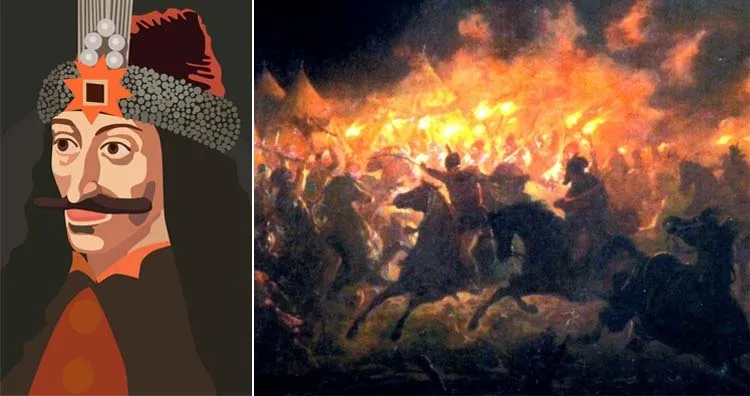
Vlad the Impaler: The Historical Figure Behind the Terror of Wallachia
Vlad III, known as Vlad the Impaler or Vlad Dracula, was the Prince of Wallachia during the 15th century and is widely remembered for his extreme cruelty, particularly his preferred method of execution—impalement. Born in 1431 in the region of Transylvania, Vlad came to power in Wallachia during a time of significant political instability, and his reign was marked by constant warfare, shifting alliances, and his brutal methods of maintaining control.
Vlad’s legacy is infamous, primarily due to his widespread use of impalement as a method of both punishment and psychological warfare. Though he ruled Wallachia for only brief periods (1448, 1456–1462, and 1476), his actions earned him a lasting place in history as one of the most feared rulers of medieval Europe. While some Romanians regard him as a national hero for defending his land from Ottoman invasion, his reign is equally remembered for the terror he inflicted on his own people and enemies alike.
The Early Life of Vlad III
Vlad III was born into the noble Drăculești family in 1431, the second son of Vlad II Dracul, a member of the Order of the Dragon, a chivalric order dedicated to defending Christianity against the Ottoman Turks. His father’s title, Dracul, meaning “dragon” in Romanian, was passed on to his son, giving rise to Vlad III’s moniker, “Dracula”, meaning “son of the dragon.”
Vlad’s early life was marked by political intrigue and violence. In 1442, as a political hostage to the Ottoman Empire, Vlad and his brother Radu were taken to the Ottoman court to ensure their father’s loyalty to the Sultan. This period of captivity had a profound impact on Vlad, shaping his later policies and tactics. While Radu eventually sided with the Ottomans, Vlad’s experience instilled in him a deep hatred for the Turks.
Vlad III’s Reign: The Brutal Ruler of Wallachia
Vlad III first came to power in Wallachia in 1448, though his initial rule was short-lived due to conflicts with rivals. His most significant period of rule came between 1456 and 1462, during which he consolidated his power and ruthlessly crushed any opposition. During this time, Vlad used impalement as his primary method of execution, earning him the nickname “Vlad the Impaler”.
Impalement was a particularly gruesome form of execution in which a long, sharp stake was inserted into the victim’s body—usually through the rectum or vagina—and gradually forced upwards, often emerging through the shoulder, neck, or mouth. The victims were left to die slowly in agonizing pain, and the sight of impaled corpses was used to instill terror in both Vlad’s enemies and his subjects.
The scale of Vlad’s brutality was enormous. Historical accounts suggest that he impaled tens of thousands of people during his reign. His victims included enemy soldiers, political rivals, common criminals, and entire villages that were deemed disloyal. In one particularly notorious incident in 1462, Vlad impaled an estimated 20,000 Ottoman soldiers near the city of Târgoviște, creating what became known as the “Forest of the Impaled.” When the Ottoman Sultan Mehmed II advanced on Wallachia, he was met with the horrifying sight of thousands of corpses impaled on stakes, reportedly causing him to retreat in shock.
Impalement as a Tool of Psychological Warfare
Vlad’s use of impalement was not only a method of punishment but also a calculated tactic of psychological warfare. By publicly displaying the bodies of his enemies, Vlad sent a powerful message that dissent would not be tolerated. The sheer brutality of the practice instilled fear and submission among his subjects, while also deterring potential invaders.
Vlad’s reign was also characterized by strict enforcement of law and order. He is said to have despised dishonesty and theft and employed draconian punishments for even minor offenses. For example, one story recounts how Vlad placed a gold cup in the central square of Târgoviște and allowed anyone to drink from it. Despite the town’s poverty, the cup was never stolen, as the fear of impalement was so great.
Vlad’s Conflicts with the Ottoman Empire
Throughout his rule, Vlad III faced constant threats from the Ottoman Empire, which sought to dominate the region. While Vlad had spent part of his youth as a hostage of the Ottomans, he fiercely resisted their attempts to exert control over Wallachia during his reign. He initially cooperated with the Hungarians and other Christian states to resist Ottoman advances.
In 1462, Vlad launched a night attack on the camp of Sultan Mehmed II, the conqueror of Constantinople, in an effort to halt an Ottoman invasion of Wallachia. While Vlad’s forces were outnumbered, the attack inflicted significant damage on the Ottoman army. However, Vlad’s victory was short-lived, as he was eventually forced to flee and seek refuge in Hungary.
Vlad’s alliances shifted frequently during this period, as he navigated the complex political landscape of Eastern Europe. He was eventually captured and imprisoned by Matthias Corvinus, the King of Hungary, in 1462. He spent several years in captivity before regaining the throne of Wallachia briefly in 1476, only to be killed in battle shortly thereafter.
The Death Toll: Vlad’s Victims
Estimates of the number of people killed by Vlad the Impaler vary widely. Some historical sources suggest that 80,000 people or more may have been executed during his reign, though the exact number is difficult to verify. Vlad’s victims included not only Ottoman soldiers but also Saxon merchants, boyars (nobles), and members of his own court. Women, children, and even infants were not spared, as Vlad’s policy of terror was all-encompassing.
Vlad’s impalement campaigns were especially brutal toward the Saxons of Transylvania, a German-speaking minority in the region. The Saxons had supported rival claimants to the Wallachian throne, and Vlad responded by laying waste to their villages, impaling their populations, and burning their homes.
Vlad the Impaler and the Dracula Legend
Vlad III’s reputation for cruelty and bloodshed became the basis for one of the most famous literary characters of all time: Count Dracula. The connection between Vlad and Bram Stoker’s Dracula lies primarily in the name. Vlad was often referred to as “Vlad Dracula”, meaning “son of Dracul” (his father, Vlad II, having been a member of the Order of the Dragon).
While Stoker’s Dracula is a fictional vampire, there is little evidence to suggest that Stoker directly based the character on Vlad the Impaler. However, the association between the historical Vlad Dracula and the fictional Count Dracula has persisted, cementing Vlad’s place in popular culture as a figure of terror and bloodlust.
Legacy: A National Hero or a Ruthless Tyrant?
Vlad the Impaler’s legacy is a complex and controversial one. In Romania, particularly in Wallachia and Transylvania, Vlad is remembered by some as a national hero who defended his homeland from the Ottoman Empire. His use of terror, while brutal, is seen by some as a necessary means of maintaining order and protecting the region from external threats.
However, Vlad’s extreme cruelty and the sheer scale of his impalement campaigns have earned him a reputation as one of the most ruthless rulers in history. Historical accounts, particularly from German and Russian chroniclers, depict him as a sadistic tyrant who took pleasure in the suffering of his victims. His actions left a trail of devastation across Wallachia, and his legacy of terror continues to haunt the region to this day.
Conclusion: Vlad the Impaler’s Bloody Reign
Vlad the Impaler remains one of the most infamous figures of medieval history. His reign of terror in Wallachia, marked by the widespread use of impalement and brutal enforcement of loyalty, has earned him a lasting reputation as a symbol of cruelty. While some view him as a defender of Christian Europe against the Ottoman Empire, others see him as a tyrant whose bloodlust knew no bounds.
Though his legacy is intertwined with the fictional vampire Dracula, the real Vlad III was a far more complex figure—one who wielded power through fear and violence in a time of constant political instability. His reign serves as a chilling reminder of the extremes to which rulers will go to maintain control and protect their thrones, regardless of the human cost.
Leave a Reply