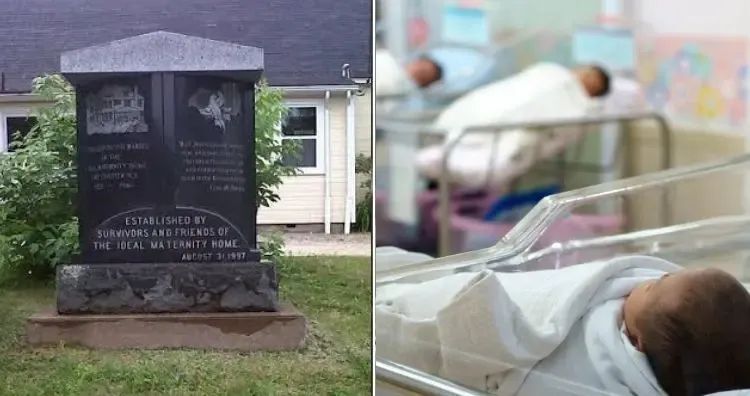
The Tragic Story of the “Butterbox Babies”: The Horrors of the Ideal Maternity Home
The Ideal Maternity Home, located in East Chester, Nova Scotia, Canada, was a maternity home that became infamous for its shocking and horrific treatment of babies born to unwed mothers. Operating from the 1920s until its closure in 1947, the home was run by William Young, an unordained minister, and his wife Lila Young, a midwife. On the surface, the home appeared to be a refuge for unmarried women, offering a place to give birth in secrecy and arrange adoptions for their newborns. However, the true nature of the Ideal Maternity Home was far more sinister.
What began as a seemingly charitable institution soon became a lucrative business for the Youngs, who preyed on desperate mothers and Jewish families seeking to adopt. The most harrowing aspect of the Ideal Maternity Home’s legacy involves the “Butterbox Babies”, a term that refers to the tragic infants who were left to die when they were deemed “unmarketable” by the Youngs. These infants were starved to death, their small bodies packed into wooden boxes resembling butterboxes, and disposed of in a variety of horrifying ways. This article delves into the disturbing history of the Ideal Maternity Home, the fate of the Butterbox Babies, and the legal and societal failures that allowed such atrocities to take place.
The Ideal Maternity Home: A Facade of Charity
The Ideal Maternity Home was founded in the early 1920s by William and Lila Young, who marketed their services as a solution for unwed mothers facing social stigma. At the time, it was highly shameful for women to bear children outside of marriage, and many sought secretive places to give birth to avoid public disgrace. The Ideal Maternity Home provided such a service, offering both delivery and adoption services. It also claimed to offer care for married couples who were struggling to conceive.
The home became widely known, attracting clients from all over Canada and the United States, particularly Jewish families from New Jersey who were eager to adopt children. In an era of widespread anti-Semitism, Jewish families often found it difficult to adopt children through traditional channels, as many adoption agencies prioritized Christian families. The Youngs exploited this desperation, charging exorbitant fees—sometimes up to $10,000—to arrange for adoptions. They took full advantage of the secrecy surrounding the adoptions, using it to inflate their profits.
However, while some babies were adopted and placed in loving homes, the fate of many others was far more tragic. Babies who were deemed “unmarketable”—often because they were sickly, physically disabled, or of mixed race—were viewed as liabilities rather than lives to be nurtured. Rather than caring for these infants, the Youngs implemented a heartless and deadly policy that led to the deaths of countless babies.
The Butterbox Babies: Starvation, Death, and Disposal
The infants who were deemed “unmarketable” by the Youngs were subjected to a cruel and calculated form of starvation. They were fed a diet of molasses and water, a substance that provided no nutritional value, effectively starving the infants to death. This method of neglect allowed the babies to die slowly, without the overt violence of other forms of murder, making it easier for the Youngs to cover up their crimes.
Once the babies died, the Youngs devised various ways to dispose of their tiny bodies. Some were buried in unmarked graves on the property, while others were burned in the furnaces of the maternity home. In some cases, the bodies were even thrown into the sea, further concealing the evidence of the home’s dark deeds. Most shockingly, the dead babies were often placed in wooden butterboxes, typically used for packaging dairy products, before being buried or disposed of. This practice led to the tragic term “Butterbox Babies”, forever tying the image of these small, innocent victims to the makeshift coffins in which they were discarded.
The exact number of infants who died under these horrific conditions remains unknown, but estimates suggest that hundreds of babies may have been deliberately starved and left to die at the Ideal Maternity Home. The precise death toll will likely never be determined, as the Youngs took great care to cover up the deaths and dispose of the bodies in ways that left little trace.
Exploitation and Deception: The Business of Baby Trafficking
The Ideal Maternity Home thrived on deception and exploitation. The Youngs not only exploited the vulnerability of unwed mothers, who were often pressured or coerced into giving up their babies for adoption, but they also preyed on the desperation of adoptive families, particularly Jewish families seeking to adopt children. Many of these families were unaware of the home’s nefarious practices and paid large sums of money for what they believed were legitimate adoptions.
Meanwhile, the unwed mothers were often required to pay for their stay at the home, adding to the Youngs’ profits. The mothers were charged for medical care, room and board, and other services, creating a financial burden that made it difficult for them to keep their babies even if they wanted to. In many cases, the mothers were pressured into signing adoption papers or leaving their babies behind when they could no longer afford to stay at the home.
For the babies who were healthy and considered “marketable,” the adoption process was relatively straightforward. However, the unmarketable babies—those who were deemed undesirable for any reason—were left to starve and die in a cruel act of neglect.
Exposure and the Closure of the Ideal Maternity Home
Despite rumors and growing concerns about the practices at the Ideal Maternity Home, the true extent of the horrors remained hidden for many years. It was not until the late 1940s that the Canadian government and law enforcement began to take action. Public scrutiny intensified when a series of investigations revealed the disturbing treatment of infants at the home, including the use of starvation and the disposal of dead babies in butterboxes.
In 1945, the home faced legal challenges when it was sued for improper burial practices. This case, along with growing media attention, led to further investigations that exposed the home’s illegal adoption schemes and the deaths of many infants. The home was officially closed in 1947, and the Youngs faced numerous legal battles. However, despite the evidence of their cruelty, the couple never faced criminal charges for the deaths of the infants. They were fined for illegal adoption practices but continued to live freely after the closure of the home.
The tragic story of the Butterbox Babies was largely forgotten for decades, but the horrors of the Ideal Maternity Home resurfaced in the public consciousness in the 1990s, thanks to a book titled “Butterbox Babies” by Bette Cahill, which chronicled the shocking history of the home. The book, along with a subsequent television movie adaptation, brought renewed attention to the injustices suffered by the babies and their mothers.
The Legacy of the Butterbox Babies
The legacy of the Butterbox Babies remains a haunting reminder of the dangers of unchecked power, exploitation, and the marginalization of vulnerable populations. The Ideal Maternity Home exploited both unwed mothers and adoptive families, profiting from their desperation while callously neglecting and killing the infants who were seen as unprofitable.
The story of the Butterbox Babies also serves as a cautionary tale about the lack of oversight in institutions that claim to provide care for vulnerable individuals. The fact that such atrocities could take place in a seemingly legitimate maternity home highlights the need for stronger protections and regulations in the adoption and childcare sectors.
While the closure of the Ideal Maternity Home marked the end of this dark chapter, the pain and suffering endured by the victims—both the infants who died and the mothers who were forced to give up their children—can never be undone. The families who were deceived into adopting children under false pretenses were also victims, left to grapple with the truth about the origins of their adopted children.
Conclusion: Remembering the Butterbox Babies
The Ideal Maternity Home stands as a symbol of the deep cruelty that can occur when vulnerable populations are exploited by those in positions of power. The Butterbox Babies, whose lives were cut short through neglect and starvation, are a tragic reminder of the importance of ethical standards and oversight in the care of children and the adoption process.
Though the home has long since been closed and its operators are no longer alive, the story of the Butterbox Babies continues to resonate as a call for justice and remembrance. The legacy of these innocent infants reminds us of the need to protect the most vulnerable members of society from exploitation and harm, and to ensure that no such atrocities are ever repeated.
Leave a Reply