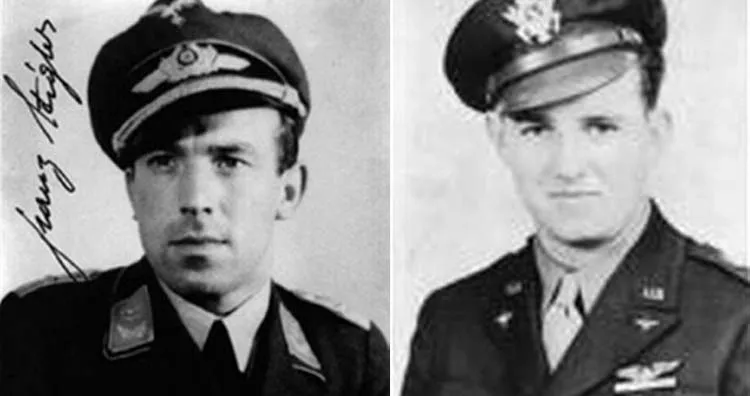
Franz Stigler: The German Fighter Pilot Who Saved a B-17 Bomber
War is often depicted in stark terms of good versus evil, friend versus foe, victory versus defeat. Yet, even in the chaos and brutality of battle, moments of extraordinary humanity sometimes emerge, transcending the violence and hatred that typically define such conflicts. One such story involves Franz Stigler, a German Luftwaffe fighter pilot, and Charlie Brown, the pilot of a crippled American B-17 bomber, in what has become known as “the most incredible encounter between enemies in World War II.”
This remarkable event took place on December 20, 1943, when Franz Stigler, an ace fighter pilot with 28 confirmed kills, risked his life by sparing and escorting a severely damaged American bomber filled with nine crewmen out of harm’s way. Rather than shoot it down as he had been trained to do, Stigler chose to honor a higher moral code, an act of chivalry that defied the norms of warfare. His decision would ultimately save the lives of the bomber’s crew and stand as a testament to the power of compassion even in the midst of one of history’s most devastating conflicts.
This story of moral courage, compassion, and redemption has been passed down through history, reminding us that even in the darkest times, humanity can shine through.
Franz Stigler: The Fighter Pilot
Franz Stigler was born on August 21, 1915, in Regensburg, Germany. He grew up in a devout Catholic family, where his parents instilled in him the values of discipline, morality, and respect. His father, a pilot during World War I, inspired Franz’s passion for aviation. By the time World War II erupted, Stigler had become an accomplished fighter pilot in the Luftwaffe, the German air force.
Stigler trained initially as a commercial pilot, flying civilian aircraft. However, like many Germans during the rise of the Nazi regime, he was called to serve in the military. When the war broke out in 1939, he was stationed in Africa, but as the conflict intensified, he was transferred back to Europe, where he flew the Messerschmitt Bf 109, one of the most advanced fighter planes of its time.
Stigler quickly rose through the ranks of the Luftwaffe, distinguishing himself as a highly skilled and deadly fighter pilot. By 1943, he had amassed 28 confirmed aerial victories, making him one of the most feared aces in the skies. His squadron, JG 27, was renowned for its combat prowess, and Stigler’s reputation for precision and efficiency as a pilot was well-known among his peers.
However, while Stigler was a formidable fighter, he was also guided by a strong sense of honor. His moral compass was shaped by the teachings of his Catholic upbringing and the influence of his early flight instructor, Gustav Rödel, who had impressed upon him the idea that aerial combat should never be about vengeance or hatred but rather about duty and survival. Rödel had told Stigler early on, “You shoot at a machine, not at a man. If I ever see or hear of you shooting someone in a parachute, I will shoot you myself.”
This principle of chivalry would become a central part of Stigler’s identity as a fighter pilot, influencing his decision-making throughout the war.
Charlie Brown and the B-17 Bomber Mission
On the other side of this incredible story was Second Lieutenant Charlie Brown, a young American bomber pilot from West Virginia. At just 21 years old, Brown was the commander of a B-17 Flying Fortress, a four-engine heavy bomber used by the United States Army Air Forces (USAAF) during World War II. The B-17 was famous for its ability to withstand significant damage and still remain airborne, earning it the nickname “Flying Fortress.”
On December 20, 1943, Brown and his crew of eight embarked on a bombing mission over Bremen, Germany. Bremen was a major industrial center, home to Focke-Wulf factories that produced fighter planes for the German Luftwaffe. The mission was part of the larger Allied bombing campaign to cripple Germany’s war production capacity and hasten the end of the conflict.
As Brown and his crew approached their target, they encountered fierce resistance from German anti-aircraft guns, or “flak,” as well as enemy fighters. Their B-17, named Ye Olde Pub, was pummeled by the heavy anti-aircraft fire, which shredded the plane’s fuselage, damaged its engines, and wounded several crew members. Despite the barrage, Brown and his crew managed to drop their bombs on the target, but the damage they had sustained was catastrophic.
As they turned to head back to their base in England, the crew of Ye Olde Pub found themselves isolated from the rest of their formation. The B-17 had lost altitude and was struggling to stay in the air. Its tail section was severely damaged, one of its engines was failing, and the crew was tending to several injured comrades. In addition to these challenges, the aircraft was leaking fuel and ammunition, making it a sitting duck for any German fighters in the area.
As the wounded bomber limped away from Bremen, it was spotted by Franz Stigler, who had just returned from a mission of his own. Seeing the lone American bomber, Stigler realized that it was an easy target—shooting it down would have been a routine matter for a pilot of his skill. Moreover, if Stigler succeeded in downing the B-17, it would bring his tally of kills to 29, putting him one step closer to earning the coveted Knight’s Cross, one of Germany’s highest military honors.
But what happened next would go down in history as one of the most remarkable encounters between enemies in the annals of war.
The Encounter
Franz Stigler had every reason to open fire on the crippled B-17. The rules of war were clear: enemy aircraft were to be destroyed on sight. German pilots were under orders to show no mercy, especially to bombers, which were responsible for devastating German cities and factories. Stigler’s duty as a Luftwaffe pilot was to protect his homeland and eliminate any threats to the Reich.
But as Stigler flew alongside Ye Olde Pub, something extraordinary happened. Instead of seeing the B-17 as just another target, Stigler looked closer and saw the human beings inside the bomber. Through the damaged windows of the aircraft, he could see the injured crew members tending to their wounded comrades. He saw the bullet holes and shrapnel scars that riddled the plane’s fuselage. The aircraft was barely holding together, and Stigler knew it would not make it back to England if it faced any more attacks.
In that moment, Stigler’s sense of honor and humanity overpowered his duty as a soldier. He recalled the words of his mentor, Gustav Rödel, who had told him that shooting a helpless enemy was not the act of an honorable man. Stigler made a decision that could have cost him his life: he would not shoot down the B-17. Instead, he would try to save the men inside.
Stigler pulled up alongside the American bomber and made eye contact with Charlie Brown, who was at the controls. At first, Brown was terrified. He assumed that the German fighter pilot was about to finish them off, and with the plane in such a dire condition, there was little they could do to defend themselves. But instead of firing, Stigler signaled to Brown, gesturing with his hands to indicate that he should try to land the plane safely.
Brown, confused and unsure of Stigler’s intentions, continued to fly the bomber. Stigler then did something even more incredible: he positioned his Messerschmitt next to the B-17 and began escorting it through German airspace. By flying so close to the bomber, Stigler protected it from German anti-aircraft guns and other Luftwaffe fighters who might have attempted to shoot it down. To any German forces observing from the ground or the air, it appeared as though Stigler was attacking the B-17, when in fact he was shielding it.
For several minutes, Stigler flew in formation with the damaged bomber, guiding it toward the North Sea, where it would be out of range of German defenses. At the edge of German airspace, Stigler gave a final salute to the American crew, then peeled away and returned to his base.
Charlie Brown and his crew, still stunned by what had just happened, managed to limp their bomber across the North Sea and back to their base in England. They had survived, not because of their skill or luck, but because of the extraordinary kindness of an enemy pilot who chose to spare their lives.
The Aftermath
After the encounter, both Stigler and Brown continued to serve in the war, but they did not speak of the incident for many years.
For Franz Stigler, sparing the B-17 and its crew was a decision that could have had serious consequences. If his superiors had learned that he had deliberately let an enemy aircraft escape, he could have been court-martialed or even executed for treason. In the Nazi regime, acts of mercy toward the enemy were not tolerated. As a result, Stigler kept the incident to himself, knowing that revealing it could put his life in danger.
Charlie Brown, meanwhile, returned to his unit and continued flying bombing missions over Europe. Like Stigler, he did not speak publicly about the encounter. While he was grateful to have survived, he wasn’t sure how to explain the act of mercy that had saved his crew. He worried that his fellow pilots might not believe him or might question his account of the events.
It wasn’t until decades later, after the war had ended and both men had retired from military service, that their incredible story came to light.
The Reunion
In the late 1980s, Charlie Brown began a search for the German pilot who had saved his life. He was determined to find out who the mysterious Luftwaffe ace was and thank him for his act of compassion. Brown’s search led him to a network of veteran pilots and aviation historians, who helped him track down Franz Stigler, who was living in Canada.
In 1990, nearly 50 years after their fateful encounter, Brown and Stigler finally met in person. The two men embraced like old friends, their bond forged not in combat but in an extraordinary moment of humanity. Brown thanked Stigler for sparing his life and the lives of his crew, and the two men quickly developed a close friendship. Over the next several years, they became like brothers, visiting each other frequently and sharing their story with the world.
Their remarkable encounter, once a secret kept out of fear and uncertainty, became a symbol of the power of kindness and moral courage. Brown and Stigler’s story was featured in numerous books, documentaries, and interviews, inspiring people around the world with its message of compassion and the triumph of humanity over hatred.
The Legacy of Franz Stigler and Charlie Brown
The story of Franz Stigler and Charlie Brown is more than just a remarkable wartime anecdote; it is a reminder of the capacity for goodness that exists even in the midst of war. In a conflict that claimed the lives of millions and was marked by unspeakable atrocities, Stigler’s decision to spare the crew of Ye Olde Pub stands out as an extraordinary act of chivalry and moral courage.
Stigler’s decision to save the American bomber crew was not just an act of kindness; it was an act of defiance against the brutal and dehumanizing nature of war itself. It was a reminder that, even in the heat of battle, soldiers on opposing sides are still human beings, deserving of compassion and respect.
For Charlie Brown and his crew, Stigler’s act of mercy gave them a second chance at life, allowing them to return home to their families and live out their lives in peace. Their gratitude for Stigler’s decision extended far beyond the immediate relief of survival; it shaped their understanding of the complexities of war and the humanity that can exist even between enemies.
Brown and Stigler’s friendship in the years after the war serves as a testament to the enduring power of forgiveness, reconciliation, and mutual respect. Their story has inspired countless people around the world to believe in the possibility of understanding and compassion, even in the most divided and hostile of circumstances.
Conclusion
The encounter between Franz Stigler and Charlie Brown is a story of extraordinary humanity in the midst of one of history’s darkest periods. It is a story of a German ace fighter pilot who risked his life to save the crew of an American bomber, not out of duty, but out of a profound sense of morality and honor. Stigler’s decision to spare Ye Olde Pub and its crew, and the lasting friendship that developed between him and Charlie Brown, remind us that even in the most violent and dehumanizing circumstances, acts of kindness and compassion can prevail.
Their story serves as a powerful reminder that war, with all its devastation and tragedy, cannot extinguish the basic human capacity for empathy and compassion. Even in the darkest moments of conflict, the light of humanity can shine through. The legacy of Franz Stigler and Charlie Brown lives on as a symbol of the power of moral courage, the strength of compassion, and the enduring hope for reconciliation and peace.
Leave a Reply