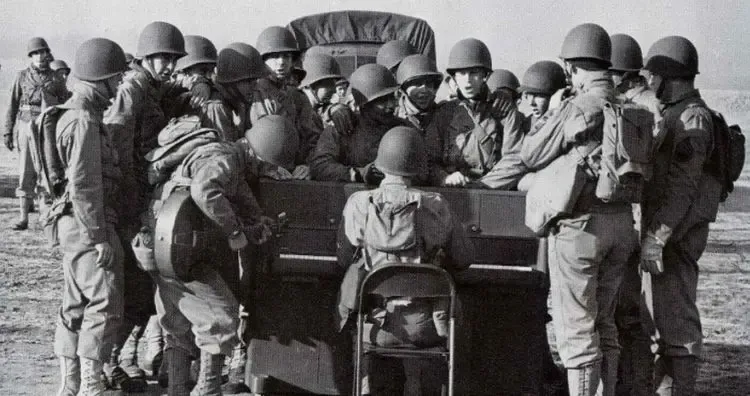
G.I. Steinways: The Story of Steinway & Sons’ Pianos Dropped into Battle for American Troops
During World War II, American troops faced grueling battles and long stretches of tension-filled downtime. Amidst the chaos and intensity of the war, one company sought to provide soldiers with a moment of peace, relaxation, and even joy: Steinway & Sons, the legendary piano manufacturer. Known for crafting some of the finest pianos in the world, Steinway & Sons contributed to the war effort in an unexpected way by air-dropping specially designed pianos—known as “G.I. Steinways”—into battle zones for American soldiers. These pianos, parachuted into remote locations, provided an escape from the stresses of war through music.
These G.I. Steinways were specially constructed to withstand the harsh conditions of war, coated in dark blue, grey, or olive drab finishes to blend with military equipment. They came complete with tuning instructions, making it possible for soldiers to maintain them and enjoy music even in the middle of a battlefield. In this article, we will explore the history of Steinway’s contributions to the war, the story behind these air-dropped pianos, and the significance of music during one of the most challenging times in modern history.
Steinway & Sons: A Legacy of Excellence
Founded in 1853 by German immigrant Heinrich Engelhard Steinweg, later known as Henry Steinway, Steinway & Sons quickly established itself as one of the most respected piano manufacturers in the world. The company’s pianos were celebrated for their exceptional craftsmanship, tonal quality, and innovation. By the time World War II began, Steinway pianos were a symbol of musical excellence and could be found in concert halls, homes, and schools across the United States and Europe.
When the war broke out in 1939, Steinway & Sons, like many other American manufacturers, shifted part of its production to support the war effort. While most companies contributed by producing military equipment, ammunition, or vehicles, Steinway continued to produce pianos—though not for civilian use. The company’s dedication to quality and craftsmanship would soon find a new purpose on the battlefield, as Steinway’s pianos were used to provide a much-needed respite for soldiers during the war.
Music and Morale: The Role of Music in Wartime
Throughout history, music has played an essential role in boosting the morale of soldiers. During times of war, music has been used to rally troops, lift spirits, and provide a temporary escape from the harsh realities of combat. In World War II, music was especially important for maintaining the emotional and psychological well-being of soldiers who were far from home and facing constant danger.
Military bands and USO (United Service Organizations) performances were commonplace in the theaters of war, with entertainers like Glenn Miller, Bing Crosby, and the Andrews Sisters traveling to war zones to perform for American troops. These performances gave soldiers a sense of connection to home and a brief reprieve from the grimness of the battlefield. However, for soldiers stationed in remote locations or those engaged in long, drawn-out campaigns, access to music could be limited.
This is where Steinway & Sons stepped in. Recognizing the need for a way to bring music to the frontlines, Steinway developed a solution that would allow soldiers to create their own music, no matter where they were stationed. These pianos would not only serve as a source of entertainment but also as a reminder of the comforts of home.
The G.I. Steinways: Pianos Designed for the Battlefield
In 1942, Steinway & Sons began producing the Victory Vertical Piano, commonly referred to as the G.I. Steinway, for the U.S. military. These pianos were specially designed to be smaller, more portable, and durable enough to withstand the rigors of war. Traditional concert pianos, with their glossy finishes and delicate components, were not suitable for the battlefield, so Steinway engineers set out to create a piano that could be deployed in war zones and still provide a high-quality musical experience.
The G.I. Steinways were built with a vertical, upright design, as opposed to the larger grand pianos that Steinway was best known for. The upright design allowed for easier transport and handling in the field. To ensure that the pianos could endure the harsh conditions of war, Steinway replaced the usual wood veneers with more durable materials and finished the pianos in military colors—dark blue, grey, and olive drab—so they would blend in with the equipment used by American forces.
Additionally, these pianos were built with simplicity in mind. Each G.I. Steinway came with a set of tuning instructions so that soldiers could tune the piano themselves, even if they were not professional tuners. These instructions proved invaluable, as the pianos were often subjected to fluctuating temperatures, humidity, and rough handling, all of which could cause the instrument to go out of tune. The ability to tune the piano in the field meant that soldiers could maintain the instrument and continue to enjoy its music over extended periods.
The pianos were compact enough to be transported by jeep or even air-dropped into battle zones via parachute. They were packed securely in crates and outfitted with large parachutes that would ensure a safe landing. Once on the ground, the pianos could be set up quickly and were ready to play. For soldiers who had spent days or weeks on the frontlines, the sight of a parachuting piano must have been an extraordinary moment of relief and excitement.
Music on the Frontlines: Soldiers and Their Pianos
The impact of the G.I. Steinways on the morale of American soldiers cannot be understated. For many soldiers, access to music was a way to cope with the extreme stress and emotional toll of warfare. Playing a piano allowed them to temporarily escape from the violence and chaos around them, providing a sense of normalcy and peace amidst the turmoil of battle.
Soldiers used the pianos for a variety of purposes. Some gathered around to sing popular songs of the day, such as “Boogie Woogie Bugle Boy” or “In the Mood”, while others played classical pieces or improvised tunes that reminded them of home. In some cases, soldiers who were skilled musicians took on the role of the camp pianist, playing for their fellow troops in makeshift concerts or during moments of downtime.
The pianos also provided a connection to loved ones back home. Soldiers would sometimes write letters to their families, describing the experience of playing or hearing a piano in the field. For many, these moments of music were a rare opportunity to relax and reflect, offering a brief reprieve from the brutality of combat.
In a letter from the frontlines, one soldier wrote:
“When you’re out here, surrounded by the noise of war, there’s something about hearing a piano that takes you back. For a little while, you can close your eyes and forget about everything. It’s like being home again, if only for a moment.”
This sentiment was shared by countless soldiers who experienced the joy and comfort of hearing a piano in the midst of war.
The Logistics of Air-Dropping Pianos
While the idea of air-dropping pianos into a war zone may seem unusual, the logistics of such an operation were surprisingly effective. The G.I. Steinways were designed to be as lightweight and durable as possible, making them suitable for transport by air. The pianos were packed into crates that were specially designed to absorb the impact of landing, ensuring that the instruments were not damaged when they reached the ground.
The parachutes used to drop the pianos were large enough to slow the descent of the crates, allowing them to land gently in designated drop zones. In some cases, the pianos were delivered directly to military camps, where soldiers would eagerly unpack them and set them up. In other instances, the pianos were dropped into more remote areas, where they could be retrieved and brought to the frontlines.
Once on the ground, the pianos were quickly put to use. Soldiers would gather around to listen to the music or take turns playing the instrument. The presence of a piano often became a focal point for camaraderie and relaxation, with troops using the opportunity to bond over shared memories of home or favorite songs.
The Cultural Impact of the G.I. Steinways
The G.I. Steinways not only provided soldiers with a source of entertainment and relaxation, but they also played a role in preserving American culture during the war. Music, and especially piano music, was a deeply ingrained part of American life during the 1940s. Songs from Broadway shows, jazz standards, and popular tunes filled the airwaves back home, and these same songs were carried to the frontlines through the pianos.
The pianos became a way for soldiers to stay connected to the cultural life of the United States, even as they fought in distant lands. The familiar melodies reminded them of their families, friends, and the lives they had left behind, providing comfort and reassurance in the face of uncertainty.
In addition to popular music, some soldiers used the pianos to play classical music, reflecting the diverse musical tastes of the troops. Whether it was a rendition of Beethoven’s Moonlight Sonata or a rousing performance of Gershwin’s Rhapsody in Blue, the pianos allowed soldiers to express their creativity and enjoy a cultural connection that transcended the horrors of war.
Post-War Legacy and the Enduring Story of the G.I. Steinways
After the war, the story of the G.I. Steinways became part of the larger narrative of how American companies contributed to the war effort. Steinway & Sons had not only supported the war by producing these special pianos but had also helped sustain the emotional and psychological well-being of soldiers through the power of music.
Many of the G.I. Steinways survived the war, and some were brought back to the United States, where they became treasured keepsakes for returning veterans. Others remained in Europe, where they continued to be used by soldiers stationed in post-war occupation zones.
The legacy of the G.I. Steinways lives on in the history of both Steinway & Sons and the broader story of World War II. The pianos represent more than just instruments—they symbolize the resilience of the human spirit and the importance of creativity and culture, even in the darkest of times.
Conclusion: A Musical Gift in the Midst of War
The story of Steinway & Sons and the G.I. Steinways is a testament to the power of music to uplift, inspire, and provide comfort during times of unimaginable hardship. By air-dropping pianos into battle zones, Steinway & Sons brought a sense of normalcy and joy to soldiers who were facing the harsh realities of war.
The G.I. Steinways were more than just pianos—they were symbols of hope, reminders of home, and a source of emotional strength for the men who played them. Through music, soldiers found a way to connect with one another, to relax, and to momentarily forget the violence surrounding them.
In the annals of World War II history, the G.I. Steinways stand out as a unique and heartwarming chapter, illustrating how even in the midst of conflict, the arts have the power to heal and to bring people together.
Leave a Reply