A Comprehensive History of the Freemasons
The Comprehensive History of Freemasonry: Origins, Influence, and Legacy
Table of Contents
Introduction
The Origins of Freemasonry
Early Mason Guilds and Medieval Stoneworkers
Transition from Operative to Speculative Freemasonry
The Formation of the Grand Lodge of England (1717)
The Spread of Freemasonry Across Europe
Freemasonry in the American Colonies and the Birth of a Nation
Freemasonry’s Role in Revolutionary Movements
The Symbols, Rituals, and Degrees of Freemasonry
The Role of Freemasonry in the Enlightenment
The Anti-Masonic Movement and Conspiracy Theories
Freemasonry in the 19th Century
Freemasonry and the American Civil War
Freemasonry’s Influence on Politics and Society
Freemasonry in the 20th Century
Freemasonry in Modern Times
Famous Freemasons and Their Contributions to Society
Freemasonry’s Global Presence
Challenges and Criticisms of Freemasonry
Conclusion: The Legacy and Future of Freemasonry
Chapter 1: Introduction
Freemasonry, one of the world’s oldest and most enigmatic fraternal organizations, has a deep and intriguing history that spans centuries. Its exact origins remain clouded in mystery, with many theories surrounding its evolution from medieval stonemason guilds to its modern form, which embraces symbolic and philosophical tenets. What is clear is that Freemasonry has played an influential role in politics, social reform, philanthropy, and enlightenment thought, with prominent figures from across history counted among its members.
This document seeks to provide a comprehensive exploration of Freemasonry, tracing its development from its earliest beginnings, through its golden age, its societal impacts, and its controversial elements, to its role in modern society. Freemasonry’s core principles of brotherhood, self-improvement, and ethical living have permeated many facets of Western culture, and the organization continues to inspire fascination and debate in equal measure.
Chapter 2: The Origins of Freemasonry
The precise origins of Freemasonry are difficult to determine, and theories about its beginnings are often speculative. However, it is widely believed that Freemasonry evolved from the medieval stonemason guilds of Europe. These early guilds were associations of skilled builders responsible for constructing many of the magnificent cathedrals, castles, and public buildings that stand in Europe today.
Stonemason Guilds
During the Middle Ages, these guilds maintained a system for the training, support, and regulation of skilled craftsmen. Stonemason guilds provided professional and social support to their members and worked to preserve trade secrets and standards of workmanship. Stonemasons traveled from city to city, finding work where construction projects were underway, and the guild system ensured that their skills were recognized and respected.
Within these guilds, members would gather in lodges, which functioned as both meeting places and workshops. Over time, these lodges developed rituals, customs, and symbols that differentiated their members and reinforced the bonds of brotherhood within the guild. These same rituals and symbols would later be adopted by the Freemasons, transforming what was once a guild of operative masons into an organization of speculative masons.
Chapter 3: Early Mason Guilds and Medieval Stoneworkers
The work of medieval stonemasons was central to some of the most significant architectural achievements of the time. Building large-scale structures such as cathedrals required not only technical skill but also the coordination of many artisans working together. This contributed to the formation of close-knit communities among stonemasons, reinforced by guilds that regulated the profession and fostered a sense of shared identity.
Operative Masonry
The original stonemason guilds were known as operative masons, as they engaged in the actual craft of cutting and shaping stone. These guilds protected the economic interests of their members, ensuring that work was distributed fairly and that apprentice stonemasons were trained according to established standards. The guilds also served a social function, providing care for members in times of sickness or injury and supporting the families of deceased masons.
As part of the guild’s structure, masons were divided into ranks or degrees. An apprentice would begin by learning the basic skills of stonecutting under the supervision of a master mason, before eventually advancing to the rank of fellowcraft, where they took on greater responsibilities. Finally, the most experienced and skilled masons could achieve the rank of master mason.
The structure of these guilds, with their use of degrees, secret knowledge, and ritualistic elements, would become integral to speculative Freemasonry.
Chapter 4: Transition from Operative to Speculative Freemasonry
In the late 16th century, something remarkable began to happen: people who were not professional stonemasons started joining the mason lodges. These “speculative masons” included intellectuals, aristocrats, and other influential individuals who were drawn to the guilds’ traditions, symbols, and moral teachings. Over time, the focus of these lodges shifted from the practical craft of stonecutting to more abstract and philosophical concerns, leading to the creation of speculative Freemasonry.
The Birth of Speculative Freemasonry
While the early mason guilds were primarily concerned with regulating the building trade, speculative Freemasonry used the symbols and tools of stonemasonry to explore deeper philosophical and ethical concepts. The square, compasses, and other tools of the trade became moral symbols, representing principles such as integrity, fairness, and self-discipline.
The emphasis of speculative Freemasonry was on self-improvement and the cultivation of virtue, with members engaging in discussions about philosophy, ethics, and the mysteries of the universe. The meetings of these speculative lodges became opportunities for intellectual and spiritual growth, where members could reflect on their personal development in the context of broader philosophical ideas.
Chapter 5: The Formation of the Grand Lodge of England (1717)
A defining moment in the history of Freemasonry came in 1717 with the formation of the Grand Lodge of England in London. Four lodges in London came together to form this centralized governing body, marking the transition from small, independent lodges to a unified Masonic organization.
Significance of the Grand Lodge of England
The establishment of the Grand Lodge marked the formal organization of Freemasonry and helped standardize Masonic practices, rituals, and structures. The Grand Lodge of England took steps to create consistency among Masonic lodges, ensuring that they followed common guidelines and procedures. This structure allowed Freemasonry to expand more efficiently, and new lodges soon began appearing across Britain and Europe.
The formation of the Grand Lodge also helped establish Freemasonry as a philosophical movement, emphasizing the moral and ethical dimensions of its teachings. This era marked the beginning of modern Freemasonry as we know it today.
Chapter 6: The Spread of Freemasonry Across Europe
Following the establishment of the Grand Lodge of England, Freemasonry spread quickly across Europe. By the mid-18th century, Masonic lodges had been established in countries such as France, Germany, Italy, and Spain, each adapting Freemasonry to its unique cultural and political environment.
Freemasonry in France
Freemasonry became particularly influential in France, where it was associated with the intellectual and political movements of the Enlightenment. Many prominent French intellectuals, including Voltaire, were Freemasons, and they embraced the Masonic values of rationality, liberty, and equality. French Masonic lodges became centers of intellectual discourse, where discussions about philosophy, science, and politics flourished.
The ideals promoted by Freemasonry—particularly its emphasis on equality and brotherhood—resonated with the revolutionary sentiments that would later culminate in the French Revolution.
Freemasonry in Germany
In Germany, Freemasonry was also associated with philosophy and intellectual inquiry, attracting figures like Johann Wolfgang von Goethe and other luminaries of the German Enlightenment. Freemasonry in Germany was closely linked to mysticism and Rosicrucianism, with a focus on personal transformation and spiritual enlightenment.
Freemasonry became a vehicle for the transmission of progressive ideas in 18th-century Europe, playing a key role in shaping the intellectual landscape of the time.
Chapter 7: Freemasonry in the American Colonies and the Birth of a Nation
Freemasonry arrived in the American colonies in the early 18th century, with the first Masonic lodge established in Boston in 1733. Freemasonry quickly became popular in the colonies, attracting many influential figures who would later become central to the founding of the United States.
Freemasons and the American Revolution
Freemasonry played a significant role in the American Revolution, with many of the Founding Fathers counted among its members. Prominent Freemasons such as George Washington, Benjamin Franklin, Paul Revere, and John Hancock were instrumental in shaping the new nation, and they embraced the Masonic ideals of liberty, justice, and equality.
The Masonic lodges in the colonies became places where revolutionary ideas could be discussed openly, and they fostered a spirit of camaraderie and mutual support among the colonists. The symbolism and rituals of Freemasonry also found their way into the founding documents of the United States, including the Declaration of Independence and the Constitution.
The all-seeing eye and the unfinished pyramid, symbols commonly associated with Freemasonry, were incorporated into the design of the Great Seal of the United States, further solidifying the connection between Freemasonry and the American Revolution.
Chapter 8: Freemasonry’s Role in Revolutionary Movements
Freemasonry has long been associated with revolutionary movements around the world, particularly during the 18th and 19th centuries. The organization’s emphasis on liberty, equality, and fraternity made it a natural ally of those seeking to overthrow oppressive regimes and establish democratic governments.
The French Revolution
Freemasonry played an influential role in the French Revolution, with many key revolutionaries being members of Masonic lodges. The ideals of liberty, equality, and brotherhood promoted by Freemasonry aligned with the revolutionary calls for the abolition of the monarchy and the establishment of a republican government. While the exact extent of Freemasonry’s influence on the revolution remains debated, there is no doubt that Masonic lodges were a forum for the exchange of revolutionary ideas.
Latin American Independence Movements
Freemasonry also played a significant role in the Latin American independence movements of the early 19th century. Leaders such as Simón Bolívar, José de San Martín, and Bernardo O’Higgins were Freemasons, and they used Masonic lodges as places to organize and strategize their efforts to liberate Latin America from Spanish rule.
Freemasonry’s principles of self-determination and individual liberty provided the intellectual framework for these revolutionary movements, and the organization became closely associated with the struggles for independence throughout the Americas.
Chapter 9: The Symbols, Rituals, and Degrees of Freemasonry
Freemasonry is known for its extensive use of symbols, rituals, and degrees, all of which serve to reinforce its teachings and structure. These elements are central to Masonic tradition and play a key role in the initiation and advancement of members.
Common Masonic Symbols
Freemasonry employs a wide range of symbols drawn from the tools and practices of stonemasonry. Some of the most important Masonic symbols include:
The Square and Compasses: The most recognizable symbol of Freemasonry, representing the tools used by stonemasons to ensure accuracy and precision. The square symbolizes moral integrity, while the compasses represent self-restraint and the importance of maintaining ethical boundaries.
The All-Seeing Eye: This symbol is often associated with the idea of divine providence, suggesting that a higher power watches over human affairs. In Masonic symbolism, it represents the belief that God, often referred to as the Great Architect of the Universe, observes all of creation.
The Pillars of Solomon’s Temple: The two pillars, Jachin and Boaz, are important symbols in Freemasonry, representing strength and wisdom. These pillars are said to have stood at the entrance of Solomon’s Temple in Jerusalem, and they are used in Masonic ritual to convey spiritual and moral lessons.
Rituals and Degrees
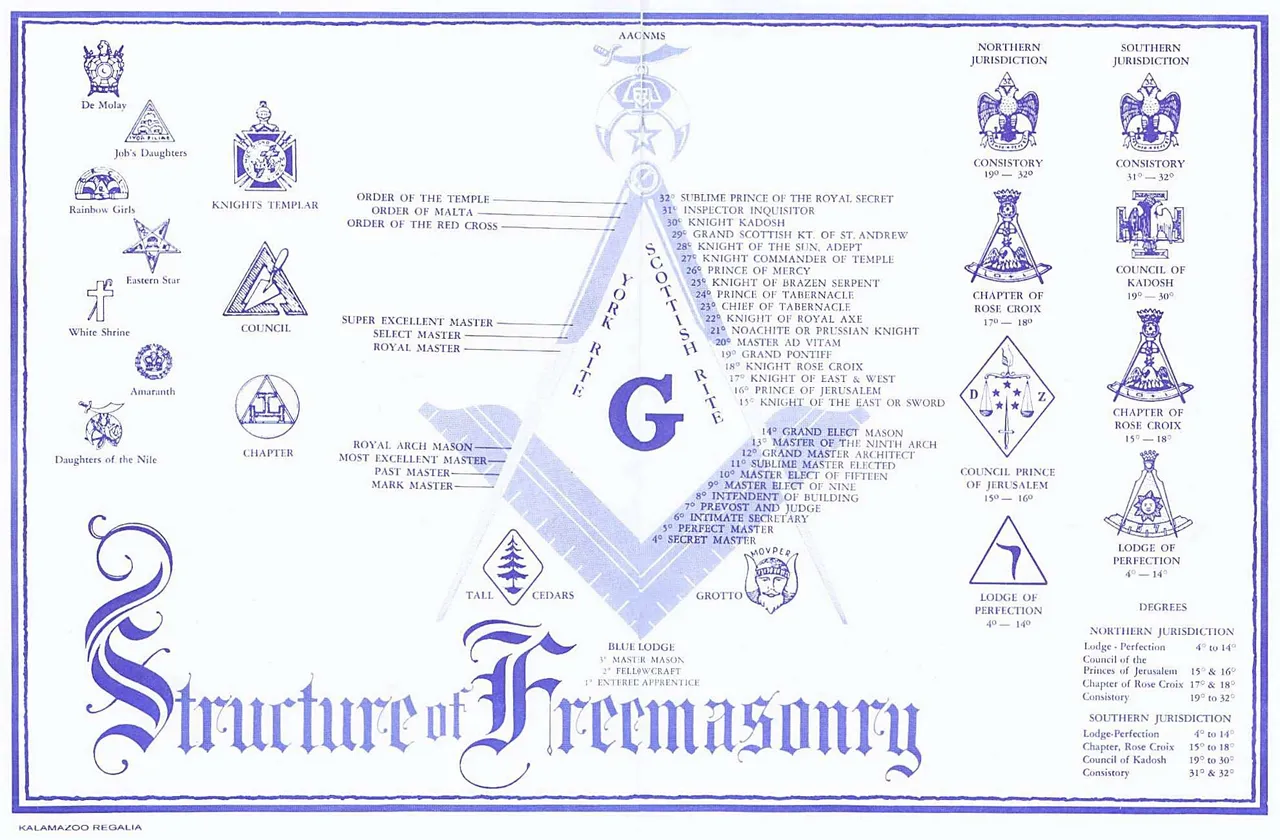
Freemasonry is organized into a system of degrees, each of which represents a different level of knowledge and moral development. The core degrees in Freemasonry are:
Entered Apprentice: The first degree, which focuses on the foundational virtues of a Freemason, such as humility, integrity, and a commitment to self-improvement.
Fellowcraft: The second degree, which emphasizes intellectual growth and the development of one’s moral and philosophical understanding.
Master Mason: The third and highest degree in Blue Lodge Freemasonry. The Master Mason degree is rich in symbolism and teaches important lessons about mortality, the afterlife, and the pursuit of virtue.
In addition to these core degrees, there are many additional degrees and rites in Freemasonry, including the Scottish Rite and the York Rite, each of which offers further opportunities for learning and advancement.
Chapter 10: The Role of Freemasonry in the Enlightenment
The 18th century was a time of great intellectual and social change, often referred to as the Enlightenment. Freemasonry played a significant role in this movement, as it provided a space for the exchange of progressive ideas about reason, liberty, and tolerance.
Freemasonry as a Forum for Enlightenment Thought
Freemasonry’s emphasis on rationality, science, and moral improvement made it a natural ally of the Enlightenment thinkers who sought to challenge traditional authority and promote new ways of understanding the world. Masonic lodges became centers of intellectual exchange, where members could discuss the latest developments in philosophy, science, and politics.
Many of the leading figures of the Enlightenment were Freemasons, including Voltaire, Benjamin Franklin, and Denis Diderot. These individuals helped to spread Enlightenment ideals through their writings and public engagements, and Freemasonry became associated with the broader cultural movement toward secularism, democracy, and universal human rights.
Chapter 11: The Anti-Masonic Movement and Conspiracy Theories
Despite its contributions to the intellectual and political advancements of the Enlightenment, Freemasonry has often been the target of suspicion and conspiracy theories. Its secretive nature, combined with the influence of its members, has led some to view Freemasonry as a shadowy organization working behind the scenes to manipulate political and social events.
The Anti-Masonic Movement in the United States
One of the most significant challenges to Freemasonry came in the early 19th century with the rise of the Anti-Masonic Movement in the United States. This movement was sparked by the Morgan Affair in 1826, in which William Morgan, a man who threatened to expose the secrets of Freemasonry, mysteriously disappeared. His disappearance was widely blamed on the Freemasons, leading to a public outcry and the formation of the Anti-Masonic Party, the first third-party movement in American politics.
The Anti-Masonic Movement accused the Freemasons of corruption, elitism, and undue influence over political and economic institutions. While the movement eventually faded, it marked the beginning of a long tradition of anti-Masonic sentiment that continues to this day.
Conspiracy Theories
Freemasonry has been the subject of countless conspiracy theories over the centuries. Some of the most common allegations include that Freemasons control world governments, banks, and media outlets, and that they are part of a secret cabal working to establish a New World Order. These conspiracy theories often draw on the organization’s secrecy, its use of esoteric symbols, and its connections to influential figures throughout history.
While these conspiracy theories lack credible evidence, they have contributed to the enduring sense of mystery and intrigue that surrounds Freemasonry.
Chapter 12: Freemasonry in the 19th Century
The 19th century was a period of significant growth and change for Freemasonry, as the organization expanded into new territories and adapted to the shifting political landscape of the time. In Europe, Freemasonry became closely associated with the rise of liberalism and nationalism, while in the United States, it played a key role in the promotion of social reform.
Freemasonry and Social Reform
Freemasonry’s emphasis on equality, brotherhood, and charity made it a natural ally of many of the social reform movements of the 19th century. Masonic lodges supported causes such as the abolition of slavery, the promotion of public education, and the advancement of civil rights.
In addition to its support for progressive causes, Freemasonry also became a platform for personal and social improvement, with members encouraged to engage in charitable work and contribute to the betterment of their communities. Masonic lodges became important centers of philanthropy, raising funds for hospitals, schools, and orphanages.
Chapter 13: Freemasonry and the American Civil War
The American Civil War (1861-1865) was one of the most divisive and destructive conflicts in American history, but Freemasonry provided a rare point of unity during this tumultuous period. Both Union and Confederate soldiers who were Freemasons found ways to support one another, even in the midst of battle.
Masonic Brotherhood During the War
Freemasons on both sides of the conflict adhered to the principle of universal brotherhood, recognizing that their obligations to one another as Masons transcended the political divisions of the war. There are numerous accounts of Masonic soldiers from opposing sides showing mercy to one another on the battlefield, offering medical assistance, and even facilitating the safe return of prisoners.
One famous example occurred during the Battle of Gettysburg, when a Confederate officer, recognizing a wounded Union soldier as a fellow Mason, arranged for him to be safely transported to a nearby hospital. Such acts of kindness demonstrated the strength of Masonic values, even in times of great national strife.
Chapter 14: Freemasonry’s Influence on Politics and Society
Freemasonry has had a profound influence on the politics and society of many countries, particularly in Europe and North America. The organization’s core principles of democracy, tolerance, and equality have shaped the political ideologies of its members, many of whom have gone on to hold prominent leadership positions.
Freemasons in Leadership
Many of the world’s most prominent political leaders have been Freemasons, including:
George Washington: The first President of the United States, whose leadership helped shape the founding principles of the American republic.
Winston Churchill: The British Prime Minister during World War II, known for his leadership during one of the most challenging periods in modern history.
Theodore Roosevelt: The 26th President of the United States, whose progressive policies helped shape modern American government.
Freemasonry’s emphasis on personal responsibility, civic duty, and ethical leadership has influenced the decisions of its members in their roles as statesmen, legislators, and diplomats.
Chapter 15: Freemasonry in the 20th Century
The 20th century presented new challenges and opportunities for Freemasonry, as the organization navigated the rise of totalitarian regimes, world wars, and social change. In some countries, Freemasonry flourished, while in others, it faced persecution and suppression.
Freemasonry and Fascism
Freemasonry was viewed with suspicion by many fascist and authoritarian regimes in the 20th century. In countries like Nazi Germany, Fascist Italy, and Francoist Spain, Freemasonry was banned, and its members were persecuted. Adolf Hitler, in particular, saw Freemasonry as a threat to his totalitarian vision, and thousands of Freemasons were imprisoned or executed during the Holocaust.
Despite these challenges, Freemasonry continued to grow and evolve in other parts of the world, particularly in the United States and the British Commonwealth.
Chapter 16: Freemasonry in Modern Times
In the 21st century, Freemasonry remains a global organization with millions of members around the world. While it no longer holds the same political influence it once did, Freemasonry continues to promote the values of philanthropy, self-improvement, and community service.
Philanthropy and Charity
One of the central missions of modern Freemasonry is charitable work. Masonic organizations raise millions of dollars each year for causes such as medical research, disaster relief, education, and child welfare. Freemasons also support local communities by funding hospitals, schools, and cultural institutions.
Chapter 17: Famous Freemasons and Their Contributions to Society
Throughout its history, Freemasonry has attracted many of the world’s most influential thinkers, leaders, and artists. Some of the most notable Freemasons include:
Wolfgang Amadeus Mozart: The legendary composer, whose works, including The Magic Flute, contain Masonic symbolism and reflect his deep connection to the fraternity.
Mark Twain: The American author and humorist, known for his wit, wisdom, and social commentary, who was an active Freemason during his lifetime.
Henry Ford: The American industrialist and founder of the Ford Motor Company, whose innovations in manufacturing revolutionized the automotive industry.
These individuals, and many others, have left an indelible mark on the world, embodying the Masonic values of creativity, leadership, and public service.
Chapter 18: Freemasonry’s Global Presence
Freemasonry is a truly global organization, with lodges in nearly every country in the world. While the traditions and rituals of Freemasonry vary from place to place, the core principles of the organization—brotherhood, charity, and moral development—remain consistent.
Freemasonry in Developing Countries
In countries such as India, South Africa, and Brazil, Freemasonry has become an important part of the social and cultural landscape. Masonic lodges in these regions engage in a wide range of charitable activities, supporting local communities through education, healthcare, and disaster relief efforts.
Freemasonry’s global reach ensures that its influence continues to be felt in diverse societies around the world.
Chapter 19: Challenges and Criticisms of Freemasonry
Despite its long history and positive contributions to society, Freemasonry has faced its share of challenges and criticisms. Some of the most common criticisms include:
Secrecy: Freemasonry’s secretive nature has led to suspicions and conspiracy theories, with some accusing the organization of operating behind closed doors to wield undue influence over governments and institutions.
Exclusivity: Historically, Freemasonry has been an exclusive, male-dominated organization. While some lodges have opened their doors to women and people of diverse backgrounds, Freemasonry continues to face questions about inclusivity and representation.
Religious Opposition: Certain religious groups, particularly the Catholic Church, have long opposed Freemasonry, viewing its emphasis on secularism and esoteric rituals as incompatible with Christian teachings.
These challenges have led to ongoing debates about the role of Freemasonry in modern society and its ability to adapt to contemporary values.
Chapter 20: Conclusion: The Legacy and Future of Freemasonry
Freemasonry’s legacy is one of intellectual inquiry, social improvement, and philanthropy. From its humble beginnings as a guild of stoneworkers to its role as a global organization, Freemasonry has shaped the course of history in profound and lasting ways.
As Freemasonry moves into the future, it will need to address the challenges of declining membership in some regions and adapt to the changing social landscape. However, its core values—brotherhood, charity, and moral integrity—remain as relevant today as they were centuries ago.
Freemasonry’s contributions to politics, society, and culture are undeniable, and its future will depend on its ability to continue inspiring individuals to strive for personal and social improvement. The legacy of Freemasonry is one of resilience, adaptability, and the enduring power of human connection.
This comprehensive exploration of Freemasonry traces its origins, evolution, and contributions to society, highlighting the organization’s profound impact on politics, culture, and intellectual thought. Through its long and storied history, Freemasonry has been a force for personal and social improvement, and its legacy continues to shape the world today.
Leave a Reply