Abu Ghraib: Torture, Abuse, and the Prison’s Legacy
Page 1: Introduction
The Abu Ghraib prison scandal is one of the most notorious incidents of detainee abuse during the Iraq War. Situated just outside of Baghdad, the prison became infamous in 2004 when photographs and reports of U.S. military personnel torturing and humiliating Iraqi prisoners surfaced. The scandal shocked the world, leading to widespread condemnation and raising serious questions about U.S. military conduct, interrogation practices, and accountability. This expanded discussion will examine the history of Abu Ghraib, the nature of the abuses, the broader context of the Iraq War, the aftermath of the scandal, and its long-term impact on both U.S. foreign policy and the global perception of America’s role in human rights.
Abu Ghraib became a symbol of the horrors of war, the consequences of unchecked power, and the ethical dilemmas posed by the use of force in counter-insurgency operations. The following pages will provide a comprehensive look at the events that unfolded at Abu Ghraib, the military and legal responses, and the broader significance of this dark chapter in modern military history.
Page 2: History of Abu Ghraib Prison
Before it became infamous for the 2004 abuse scandal, Abu Ghraib had a long and brutal history. Originally built in the 1950s, Abu Ghraib served as a notorious prison under the regime of Saddam Hussein. During his rule, the prison was synonymous with terror and repression, housing thousands of political dissidents, criminals, and suspected enemies of the state.
Saddam’s regime routinely used Abu Ghraib for torture and execution, and it became a place where many Iraqis disappeared or were tortured to death. After the U.S. invasion of Iraq in 2003, the prison was taken over by coalition forces. The U.S. military sought to use it as a detention facility for prisoners of war, suspected insurgents, and terrorists, unaware or perhaps indifferent to the grim reputation the prison already had.
The takeover of Abu Ghraib by U.S. forces in 2003 marked the beginning of a new, dark chapter in the prison’s history, as it went from a symbol of Saddam Hussein’s brutality to a site of widespread abuse perpetrated by U.S. personnel.
Page 3: The Context of the Iraq War
The abuses at Abu Ghraib cannot be fully understood without considering the broader context of the Iraq War. After the 9/11 attacks, the U.S. launched the War on Terror, first targeting al-Qaeda and the Taliban in Afghanistan and later turning its attention to Iraq, accusing Saddam Hussein of possessing weapons of mass destruction (WMDs) and supporting terrorism. In March 2003, U.S. and coalition forces invaded Iraq, quickly toppling Saddam’s regime.
The occupation of Iraq turned into a protracted conflict, with U.S. forces facing a growing insurgency. By late 2003, the security situation in Iraq had deteriorated, with frequent attacks on U.S. troops and Iraqi civilians. In this context, the U.S. military began rounding up large numbers of Iraqis, some of whom were suspected of being insurgents, while others were simply civilians caught in the wrong place at the wrong time.
The U.S. military faced immense pressure to extract intelligence from detainees to prevent further attacks. This pressure, combined with unclear guidelines on interrogation techniques and a lack of oversight, created an environment ripe for abuse at detention facilities like Abu Ghraib.
Page 4: The Emergence of the Abu Ghraib Scandal
The abuse at Abu Ghraib first came to light in April 2004, when CBS News’ 60 Minutes aired disturbing photographs showing U.S. military personnel subjecting Iraqi detainees to humiliating and abusive treatment. The photographs, taken between late 2003 and early 2004, depicted scenes of torture, sexual humiliation, and other forms of abuse.
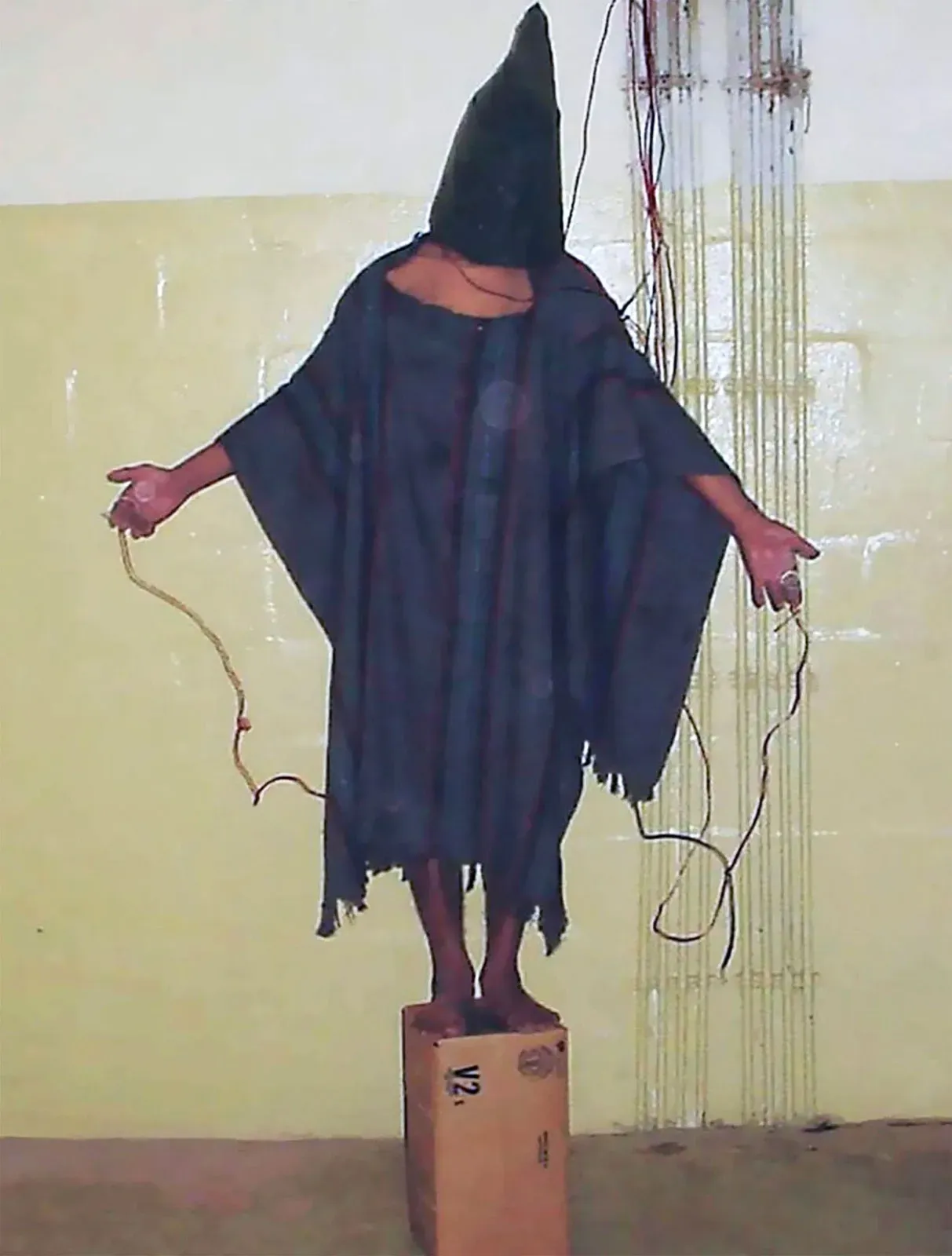
Images of detainees being piled naked, forced to assume degrading positions, subjected to mock executions, and threatened by military dogs sparked outrage around the world. In one of the most iconic images, a hooded detainee stood on a box with wires attached to his body, threatened with electrocution if he stepped off.
The media revelations triggered an immediate scandal, forcing the U.S. military and government to confront the issue publicly. The photos were initially leaked by an outraged military whistleblower, Joseph Darby, who was disturbed by the behavior of his fellow soldiers and took the courageous step of reporting the abuse.
Page 5: Nature of the Abuses
The abuses at Abu Ghraib ranged from physical violence to psychological torture. Detainees were beaten, stripped naked, and deprived of sleep. They were also subjected to sexual abuse and forced to perform degrading acts, sometimes for the amusement of the guards. Some of the most common abuses included:
Physical Assault: Beatings, stress positions, and deprivation of basic needs such as food and water.
Sexual Humiliation: Detainees were stripped naked, piled on top of one another in sexual positions, and forced to masturbate in front of female soldiers.
Psychological Torture: Prisoners were hooded, deprived of sleep, subjected to loud noises and bright lights, and threatened with death.
Use of Dogs: Military dogs were used to intimidate prisoners, with some images showing dogs lunging at naked detainees.
Investigations later revealed that some detainees died as a result of the abuse, although the exact number is still unclear. In addition, there were allegations of rape and sexual assault, though these claims remain disputed.
Page 6: Military and Government Responses
The U.S. military initially downplayed the severity of the abuses at Abu Ghraib, attributing them to a few “bad apples” rather than acknowledging broader systemic issues. However, as more details emerged, it became clear that the abuse was not limited to a small group of soldiers. Several investigations were launched in response to the scandal, including the Fay Report and the Taguba Report, which uncovered widespread abuses.
The Taguba Report, compiled by Major General Antonio Taguba, was one of the first official investigations into the scandal. The report described “sadistic, blatant, and wanton criminal abuses” of detainees by U.S. military personnel. It also pointed to serious failures in leadership and oversight at the prison.
The U.S. government, including high-ranking officials, faced international condemnation for the scandal. President George W. Bush expressed shock and disgust at the photographs and called the actions at Abu Ghraib un-American. Defense Secretary Donald Rumsfeld testified before Congress, admitting that the abuses were inexcusable, but he rejected suggestions that U.S. policy or leadership had encouraged the abuses.
Page 7: Accountability and Legal Consequences
In the wake of the Abu Ghraib scandal, a number of low-ranking U.S. soldiers were court-martialed and convicted for their roles in the abuse. The most notable among them were:
Specialist Charles Graner: A central figure in the scandal, Graner was sentenced to 10 years in prison for his role in the abuses.
Private Lynndie England: Seen in several of the notorious photographs, including one where she was holding a leash attached to a naked detainee, England was sentenced to three years in prison.
Sergeant Ivan Frederick: Convicted of multiple charges related to the abuse, including assault and maltreatment of detainees, and sentenced to eight years.
While these low-ranking soldiers were punished, critics argue that the higher-ranking officers and policymakers who authorized or failed to prevent the abuses faced little accountability. Some argue that the Bush administration’s interrogation policies, which blurred the line between acceptable and unacceptable treatment of detainees, contributed to the abuses.
In 2005, Col. Janis Karpinski, the commander of the 800th Military Police Brigade responsible for overseeing Abu Ghraib, was demoted for dereliction of duty. However, senior Pentagon officials and policymakers avoided significant consequences.
Page 8: Role of Interrogation Policies and the CIA
The Abu Ghraib scandal was closely tied to the broader debate over the U.S. government’s interrogation policies in the post-9/11 world. In the early 2000s, the Bush administration authorized the use of enhanced interrogation techniques, which many human rights organizations argue amounted to torture.
These techniques, originally developed for use by the CIA on high-value detainees at secret black sites, blurred the lines between legal interrogation and abuse. Techniques such as waterboarding, stress positions, and sleep deprivation were introduced in Iraq and elsewhere as the U.S. sought to gather intelligence on terrorist operations.
Although the CIA was not directly involved in the Abu Ghraib abuses, the prison’s guards and interrogators operated in a climate where harsh interrogation methods were implicitly condoned. Investigations later revealed that some of the techniques used at Abu Ghraib were adapted from CIA practices, leading to further criticism of the U.S. government’s handling of detainees.
Page 9: Global Reactions and Damage to U.S. Reputation
The revelations of abuse at Abu Ghraib had far-reaching consequences for the United States’ international reputation. The photographs and reports of torture sparked outrage across the globe, particularly in the Middle East, where anti-American sentiment was already high due to the U.S. invasion of Iraq.
Governments, human rights organizations, and the public in many countries condemned the actions of the U.S. military, and the scandal became a propaganda tool for extremist groups such as al-Qaeda. The abuses at Abu Ghraib were frequently cited by jihadist organizations as evidence of the U.S.’s hostility toward Muslims and its disregard for human rights.
In the years following the scandal, the U.S. faced calls for greater transparency and accountability, as well as demands for the closure of controversial detention facilities like Guantanamo Bay. The damage done to the U.S.’s moral standing in the world, particularly in the realm of human rights, was significant and long-lasting.
Page 10: Psychological Impact on Detainees and Perpetrators
The psychological impact of the Abu Ghraib abuses on both the detainees and the perpetrators has been the subject of much discussion. Many detainees experienced long-term psychological trauma, including post-traumatic stress disorder (PTSD), as a result of their treatment. The humiliation and physical abuse they endured left deep scars, both mentally and emotionally.
In addition, some U.S. military personnel involved in the abuse have expressed regret and struggled with the consequences of their actions. Soldiers like Lynndie England later claimed that they were following orders and did not fully understand the ethical implications of their behavior at the time. Others have argued that the pressure to extract intelligence, combined with poor training and leadership, contributed to the toxic environment that allowed the abuses to occur.
Psychologists have examined the factors that led ordinary soldiers to participate in such acts, noting that dehumanization of the enemy, a lack of clear moral guidance, and a permissive environment can all lead to abusive behavior in military contexts.
Page 11: The Long-Term Impact of the Abu Ghraib Scandal
The legacy of Abu Ghraib continues to shape discussions about military ethics, human rights, and U.S. foreign policy. The scandal exposed serious flaws in the U.S. military’s detention and interrogation practices, prompting calls for reform.
In the years following the scandal, there were efforts to improve oversight and accountability within the military. Some of these reforms included better training for military personnel on the treatment of detainees, clearer guidelines on acceptable interrogation techniques, and more robust mechanisms for reporting abuse.
However, the broader questions raised by Abu Ghraib—about the balance between security and human rights, the limits of acceptable conduct in wartime, and the responsibility of military and political leaders for the actions of their subordinates—remain unresolved. The scandal has become a case study in the dangers of unchecked power and the erosion of ethical standards in times of crisis.
Page 12: Conclusion and Lessons Learned
The Abu Ghraib prison scandal stands as one of the most profound moral failures of the Iraq War. The images of abuse shocked the world and forever tarnished the reputation of the U.S. military and its efforts in Iraq. The scandal highlighted the dangers of allowing ambiguity in interrogation policies, lack of oversight, and dehumanization in wartime detention facilities.
While some reforms have been implemented in the wake of the scandal, Abu Ghraib continues to serve as a grim reminder of the ethical challenges posed by modern warfare. It underscores the importance of maintaining accountability at all levels of leadership and ensuring that human rights are respected, even in the most difficult circumstances.
The lessons learned from Abu Ghraib should inform future military operations, ensuring that such abuses are never repeated and that the rule of law and human dignity remain central to U.S. military conduct.
Leave a Reply