South African Apartheid: Origins, Policies, and Legacy
Apartheid in South Africa was a system of institutionalized racial segregation and discrimination that dominated the country for much of the 20th century. It was a legal framework designed to maintain white supremacy, enforced by the ruling National Party from 1948 to 1994. Apartheid laws systematically oppressed the majority Black population, as well as other non-white groups, while elevating the white minority to positions of privilege. This system impacted every aspect of life in South Africa, from education and healthcare to employment, housing, and political representation. Its repercussions are still felt today in the form of economic inequality and racial tensions.
This expanded examination of South African apartheid explores its origins, key policies, resistance movements, and eventual demise, while considering its legacy both within South Africa and around the world.
Historical Context: Pre-Apartheid Segregation
While apartheid as a formal system was implemented in 1948, racial segregation in South Africa had roots in earlier colonial periods. The arrival of Dutch settlers (Boers) in the 17th century under the Dutch East India Company marked the beginning of white settlement in what is now South Africa. Over time, these settlers, who would come to be known as Afrikaners, established a society based on racial superiority.
By the time the British took control of the Cape Colony in 1806, the groundwork for racial hierarchy was already laid. The discovery of diamonds in 1867 and gold in 1886 accelerated the influx of European settlers and solidified the racial divide, as mining companies exploited cheap Black labor. Segregation was also legally enforced through laws such as the 1913 Natives Land Act, which restricted Black people to 7% of the land and laid the foundation for later apartheid policies.
By the early 20th century, segregation had become a fixture of South African life. However, the National Party’s electoral victory in 1948 marked a significant turning point, as apartheid became the state’s official policy.
The Rise of Apartheid: 1948 and the National Party
In 1948, the National Party won the general election on a platform that promoted apartheid, a term meaning “separateness” in Afrikaans. The party, representing the interests of the Afrikaner population, sought to entrench white supremacy by formalizing racial segregation and protecting the economic and political privileges of the white minority.
The National Party saw apartheid as a solution to the growing political and social challenges posed by an increasingly urbanized Black population. Fearing that Black South Africans would challenge their political dominance, Afrikaner leaders implemented a series of laws that enforced racial segregation across all aspects of life.
Apartheid was not just a social or political system but a comprehensive ideological framework. The policy was based on the belief that South Africa was composed of different racial groups with inherently different abilities and destinies. These racial groups, according to apartheid ideology, needed to be separated to preserve the purity of the white race and prevent the “dilution” of their culture and economic dominance.
Key Apartheid Laws and Policies
Under apartheid, a series of laws were enacted to institutionalize racial discrimination and segregation. These laws created a legal framework for the separation of races and the domination of the white minority. Some of the most significant pieces of apartheid legislation include:
Population Registration Act (1950):This law required every South African to be classified into one of four racial categories: white, Black, colored (mixed-race), or Indian. The classification determined where people could live, work, and go to school, as well as their access to services.
Group Areas Act (1950):The Group Areas Act enforced residential segregation by designating specific urban areas for different racial groups. Black people and other non-whites were forcibly removed from cities and towns, often being relocated to underdeveloped townships on the outskirts.
Bantu Education Act (1953):This law established separate education systems for different racial groups, with vastly inferior resources allocated to Black schools. The goal was to limit the education of Black South Africans, ensuring they remained in low-skilled, low-paying jobs.
Pass Laws Act (1952):Pass laws required Black South Africans to carry passbooks at all times, which specified where they could live and work. Movement was strictly controlled, and Black people needed permission from the government to travel outside designated areas.
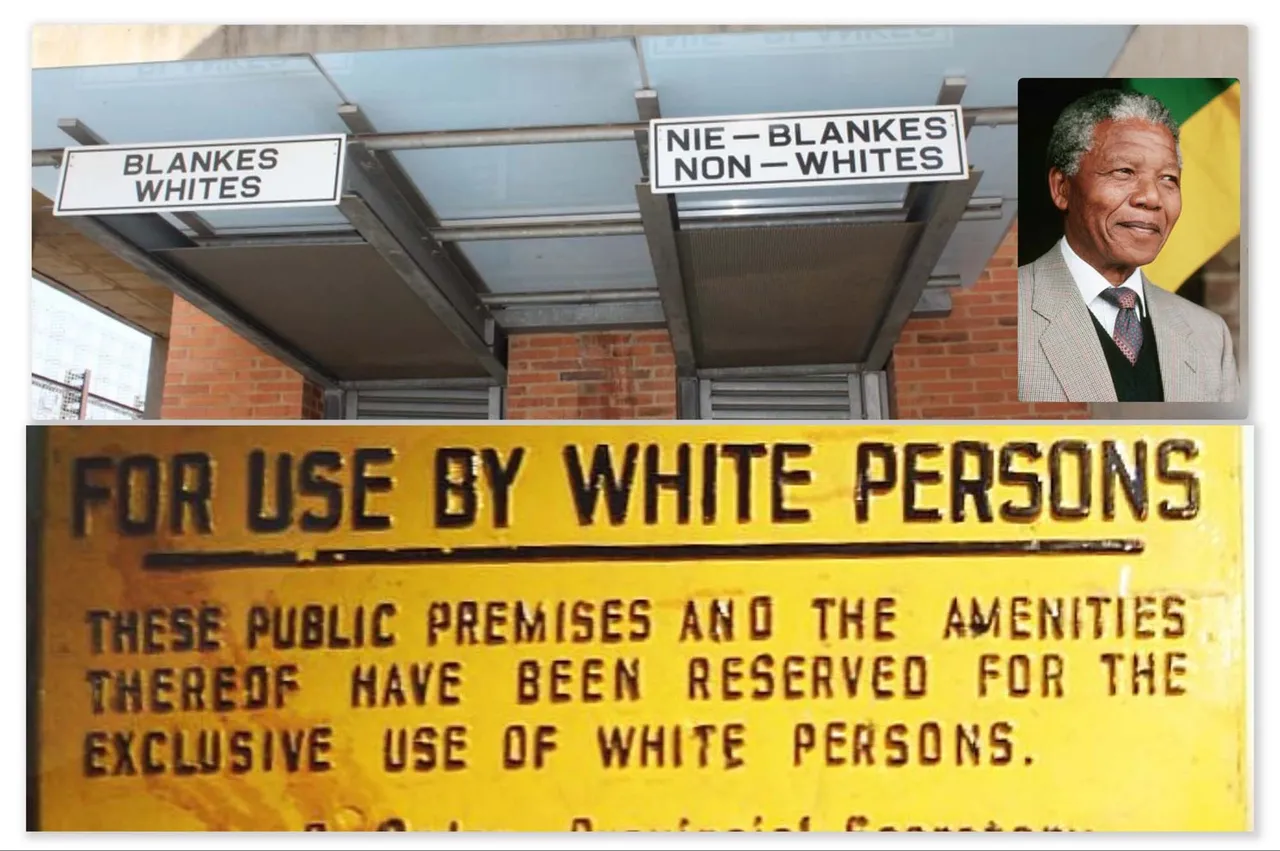
Separate Amenities Act (1953):This law segregated public facilities such as parks, beaches, buses, and restrooms. The facilities reserved for non-whites were typically far inferior to those for whites.
Homelands (Bantustans) Policy:One of the most extreme aspects of apartheid was the creation of “homelands” or Bantustans. These were semi-autonomous territories designated for different Black ethnic groups. Black South Africans were forcibly relocated to these homelands, stripping them of their South African citizenship and effectively turning them into “foreigners” in their own country.
These laws and others created a society in which racial classification determined almost every aspect of life, including employment, education, healthcare, housing, and even personal relationships.
Economic Exploitation and Racial Inequality
Apartheid’s racial segregation was not just about social control but also economic domination. The system was designed to keep the Black majority in a state of perpetual poverty and subordination, ensuring a steady supply of cheap labor for white-owned industries, especially in agriculture, mining, and manufacturing.
The apartheid economy was built on the backs of Black laborers who were paid subsistence wages and denied basic rights. Black South Africans were often forced to live in impoverished rural areas or overcrowded townships, while being required to work in cities and industries under grueling conditions. Many lived in migrant labor hostels, separated from their families for long periods.
This economic exploitation was coupled with systematic underfunding of public services for non-white communities. Schools, hospitals, and housing for Black South Africans were grossly inadequate compared to those available to whites. The economic policies of apartheid ensured that wealth, land, and resources remained concentrated in the hands of the white minority, perpetuating a vast racial wealth gap that continues to affect South Africa today.
Resistance and International Response
Throughout the apartheid era, there was widespread resistance both within South Africa and globally. Black South Africans, alongside Indian, colored, and some white allies, fought tirelessly against apartheid, often at great personal risk.
Internal Resistance Movements
The African National Congress (ANC) was the leading anti-apartheid movement. Founded in 1912, the ANC initially focused on nonviolent protests and legal challenges to segregationist policies. In the 1950s, the ANC adopted a more militant stance, organizing mass civil disobedience campaigns, such as the Defiance Campaign of 1952, and the Freedom Charter of 1955, which called for a non-racial democratic South Africa.
Other important resistance groups included the Pan Africanist Congress (PAC), the South African Communist Party (SACP), and labor unions such as the South African Congress of Trade Unions (SACTU). Many women also played crucial roles in the anti-apartheid movement, including through organizations like the Federation of South African Women, which organized protests against the pass laws.
In 1960, the Sharpeville Massacre, in which 69 unarmed Black protesters were killed by police, marked a turning point. The massacre led the ANC and PAC to abandon peaceful protest and take up armed resistance. The ANC’s military wing, Umkhonto we Sizwe (Spear of the Nation), was founded, with future president Nelson Mandela playing a key role in its activities. Mandela was arrested and sentenced to life imprisonment in 1964, becoming a symbol of the anti-apartheid struggle.
International Solidarity and Sanctions
The apartheid regime faced increasing international condemnation as the brutality of the system became widely known. The United Nations condemned apartheid as a crime against humanity, and many countries imposed economic sanctions and arms embargoes on South Africa. Anti-apartheid activists around the world organized boycotts of South African goods and divestment campaigns targeting companies that did business with the apartheid regime.
The international sports community also played a role in isolating the apartheid regime. South Africa was banned from the Olympics in 1964, and the country’s exclusion from international sporting events became a powerful symbol of global opposition to apartheid.
Despite these efforts, the apartheid government remained resilient, thanks in part to the support of key Western allies, particularly the United States and the United Kingdom, who viewed South Africa as a crucial ally in the Cold War. Nevertheless, the international pressure contributed to the weakening of the apartheid regime in the 1980s.
The Decline and Fall of Apartheid
By the late 1970s and 1980s, the apartheid system began to show signs of strain. The South African economy was faltering due to sanctions, labor strikes, and the increasing costs of maintaining the apartheid system. The internal resistance grew more powerful, with increasing protests, boycotts, and international support for the anti-apartheid movement.
Key events during this period included:
Soweto Uprising (1976): Thousands of Black students in the Soweto township protested against the use of Afrikaans as the language of instruction in schools. The peaceful protest turned violent when police opened fire, killing hundreds of students. The Soweto Uprising galvanized global opposition to apartheid and marked a new phase of militant resistance.
Formation of the United Democratic Front (UDF) (1983): The UDF was an umbrella organization uniting hundreds of anti-apartheid groups, including trade unions, religious organizations, and community groups. It became a powerful force for mobilizing mass resistance against the regime.
Economic Sanctions and Divestment: By the mid-1980s, international pressure on South Africa intensified. The United States and other countries imposed economic sanctions, and multinational companies began divesting from South Africa, further isolating the regime economically and politically.
Mass Protests and Strikes: Throughout the 1980s, mass protests, boycotts, and strikes paralyzed the South African economy and made the country increasingly ungovernable. Black workers, particularly in the mining sector, played a key role in undermining the apartheid economy through organized labor actions.
Transition to Democracy and the End of Apartheid
By the late 1980s, it became clear that apartheid could no longer be sustained. In 1989, South African President P.W. Botha resigned, and his successor, F.W. de Klerk, began a series of reforms aimed at dismantling apartheid.
In 1990, de Klerk announced the unbanning of the ANC and other anti-apartheid organizations and released Nelson Mandela from prison after 27 years. Over the next few years, intense negotiations took place between the apartheid government, the ANC, and other political groups to establish a new democratic framework.
The negotiations culminated in South Africa’s first multiracial elections in 1994. The ANC, led by Nelson Mandela, won the election, and Mandela became the country’s first Black president. The transition marked the official end of apartheid and the beginning of a new era for South Africa.
The Legacy of Apartheid
Although apartheid officially ended in 1994, its legacy continues to shape South African society. The racial and economic inequalities created by decades of apartheid have proven difficult to overcome, and the country still grapples with the effects of institutionalized racism and economic disparity.
Economic Disparities
While apartheid laws were dismantled, the economic structures that benefited the white minority remained largely intact. South Africa continues to experience vast economic inequality, with a small portion of the population, largely white, controlling most of the country’s wealth. The Black population, although legally equal, remains disproportionately affected by poverty, unemployment, and inadequate access to housing, education, and healthcare.
Truth and Reconciliation
After apartheid, South Africa sought to heal its divisions through the Truth and Reconciliation Commission (TRC), chaired by Archbishop Desmond Tutu. The TRC provided a platform for victims of apartheid-era abuses to testify, and it offered amnesty to perpetrators who fully confessed their crimes. While the TRC was praised for promoting national reconciliation, it has been criticized for failing to achieve justice for many victims of apartheid and for not adequately addressing the economic crimes of the regime.
Social and Political Challenges
South Africa’s post-apartheid government has faced significant challenges, including high levels of crime, corruption, and political instability. The ruling ANC, while initially hailed as the party of liberation, has struggled to meet the high expectations of the South African population. However, Nelson Mandela’s legacy of peace and reconciliation continues to inspire the country’s ongoing efforts to build a more just and equitable society.
Global Influence of Apartheid
The global struggle against apartheid had a profound impact on international solidarity movements and on the way racial injustice is addressed worldwide. Anti-apartheid campaigns became a model for grassroots activism, and the end of apartheid was celebrated as a victory for human rights movements globally.
Moreover, apartheid’s demise helped reshape global discussions around issues of racial discrimination, colonialism, and economic justice. It provided a powerful example of how sustained resistance, both domestically and internationally, could bring down even the most entrenched systems of oppression.
Conclusion
Apartheid in South Africa remains one of the most notorious examples of institutionalized racial segregation and oppression in modern history. The system systematically disenfranchised, exploited, and marginalized the non-white population of South Africa for nearly half a century. While the formal structure of apartheid ended in 1994, its economic and social legacy continues to affect the country.
Through the leadership of figures like Nelson Mandela and the collective efforts of resistance movements, South Africa transitioned to a democracy. However, the post-apartheid era has proven challenging, with ongoing struggles for equality, justice, and economic fairness. As South Africa continues to grapple with these issues, the world continues to study and learn from its history as a symbol of both the evils of racial oppression and the triumph of the human spirit in the fight for freedom.
Leave a Reply